Some years ago, while staying up till the wee hours while organizing something or other, I turned on the TV and flipped channels till I could find a good movie to keep me entertained while I worked. I happened to catch the beginning of a film that I'd never heard of before that night, and it turned out to be a milestone in gay-themed filmmaking, a cult classic that alternately (and sometimes simultaneously) delighted and appalled New York theatrical audiences in 1968 and then moved to the screen with the entire cast intact in 1970. That film was The Boys in the Band.
Written by openly gay playwright Mart Crowley, the play attracted celebrities and the New York in-crowd nearly instantly after it opened at a small off-Broadway theater workshop in 1968. The cast of nine male characters worked together so successfully that the whole bunch of them made the transition to the screen in 1970, which is nearly unheard of. Crowley had been a well-connected and respected but poor young writer when his play became a smash in 1968. While still a young man, he knew how the Hollywood game was played and how to jockey his success into control over the casting of the film. Working with producer Dominick Dunne he adapted his script into a screenplay and watched director William Friedkin, who also directed The French Connection and The Exorcist, lovingly keep the integrity of the play while opening it up and making it work on the screen.
It's hard to believe that the play opened off-Broadway a year before the Stonewall riots that set off the modern-day gay rights movement in New York and then swept across the country. The characters in the play, and the whole play itself, are not incidentally gay—the characters' behavior and the play's content revolve around their homosexuality. For better or worse, the characters play out, argue over and bat around gay stereotypes: the drama queen, the ultra-effeminate "nelly" fairy, and the dimwitted cowboy hustler (a likely hommage to the cowboy gigolo Joe Buck in the 1965 novel Midnight Cowboy, which was made into a remarkable film by John Schlesinger in 1969). The play also features straight-seeming butch characters who can (and do) "pass" in the outside world, and a visitor to their world who may or may not be homosexual himself.
The action takes place at a birthday party attended only by gay men who let their hair down and camp it up with some very arch and witty dialog during the first third of the film, then the party is crashed by the married former college pal of Michael, the host. A pall settles over the festivities as Michael tries to hide the orientation of himself and his guests. That is, until the party crasher brings the bigotry of the straight world into the room, and Michael realizes he's doing nobody any favors by keeping up the ruse. During the course of the evening he goes from someone who celebrates the superficial and who has spent all his time and money (and then some) on creating and maintaining a reputation and a public image, to a vindictive bully who lashes out at everyone and forces them all to scrutinize themselves with the same homophobic self-hatred he feels. He appears at first bold and unflinching in his insistence on brutal honesty, but he goes beyond honesty into verbal assault, while we see reserves of inner strength and dignity from characters we had underestimated earlier in the play. Though The Boys in the Band isn't the masterpiece that Who's Afraid of Virginia Woolf? is, I see similarities between the two in the lashing out, bullying and vindictive name-calling that alternates with total vulnerability and unexpected tenderness.
The self-loathing, high-camp hijinks, withering bitchiness and open ogling made many audience members uncomfortable, a number of homosexuals among them. Some felt the story and the characterizations were embarrassingly over-the-top and stereotyped. They thought that having the outside straight world peek in and see these characters up close would only make them disdain homosexuals even more. This is a legitimate criticism; the nasty jibes, pointed attacks, and gay-baiting that goes on among and against gay characters here is the sort of in-fighting that could encourage anti-gay bigots to become more entrenched in their bigotry when seen out of the context of a full panorama of daily life for these characters.
However, the play and film were also groundbreaking in that they depicted homosexuals as realistic, three-dimensional men with good sides and bad. Even as we watch one character try to eviscerate the others by pointing out the "gay" characteristics that make them appear weak and offensive to the straight world at large, there is also a great deal of sympathy and empathy shown among the characters under attack, and even towards the bully at times. Sometimes this tenderness is seen among characters, and sometimes it is fostered in the hearts of the audience members by the playwright as we watch people behaving badly but recognize over time how fear and self-hatred has brought them to this state.
These characters may try to hold each other up as objects of ridicule, but the strength of the dialog is that we in the audience don't buy it; with each fresh insult, we see further into the tortured souls of those who do the insulting. We see how, as modern-day sex columnist Dan Savage put it so beautifully in an audio essay about sissies on the public radio show This American Life in 2002, it is the sissies who are the bravest ones among us, for they are the ones who will not hide who they are, no matter how much scorn, derision and hate they must face as a result of their refusal to back down and play society's games. Similarly, to use another theatrical example, it is Arnold Epstein, the effeminate new recruit in the Neil Simon 1940's-era boot-camp play Biloxi Blues, who shows the greatest spine and the strongest backbone in the barracks when he does not hide what he is and is willing to take whatever punishment he is given stoically and silently so as not to diminish his honesty and integrity or let down his brothers in arms.
The situation and premise of The Boys in the Band are heightened and the campy drama is elevated for the purposes of building suspense, rather like the action in a Tennessee Williams or Eugene O'Neill play, where the uglier side of each character is spotlighted and the flattering gauze and filters over the lenses are stripped away dramatically as characters brawl and wail. The emotional breakdowns are overblown and the bitchy catcalling is nearly constant for much of the second half of the film, which I find becomes tiresome. However, the play addresses major concerns of gay American males of the 1960s head-on: social acceptability, fear of attacks by angry or threatened straight men, how to balance a desire to be a part of a family with a desire to be true to one's nature, monogamy versus promiscuity, accepting oneself and others even if they act "gayer" or "straighter" than one is comfortable with, etc.
It is startling to remember that, at the time the play was produced, just appearing to be effeminate or spending time in the company of assumed homosexuals was enough to get a person arrested, beaten, jailed or thrown into a mental institution, thrown out of his home or job, even lobotomized or given electroshock therapy in hopes of a "cure." In 1969 the uprising at the Stonewall Inn in New York City's Greenwich Village by gay men fighting back against police oppression was a rallying cry and gave homosexuals across the nation the strength to stand up for their rights and refuse to be beaten, threatened, intimidated, arrested or even killed just for being gay. However, anti-gay sentiment in retaliation for "uppity" gays coming out of the closet and forcing the heterosexual mainstream to acknowledge that there were homosexuals with inherent civil rights living among them also grew.
Cities like San Francisco, Miami, New York and L.A. became gay meccas that attracted thousands of young men and women, many of whom were more comfortable with their sexuality than the average closeted American homosexual and who wanted to live more openly as the people they really were. There was an air of celebration in heavily gay districts of these cities in the 1970s and early 1980s in the heady years before AIDS. It was a time when a week's worth of antibiotics could fight off most STDs, and exploring and enjoying the sexual aspects of one's homosexuality (because being a homosexual isn't all about sex) didn't amount to playing Russian Roulette with one's immune system, as it seemed to be by the early to mid-1980s. Indeed, of the nine men in the cast of the play and the film, I was shocked and disturbed to learn that five died of AIDS-related causes. This was not uncommon among gay male theatrical professionals who came of age in or before the 1980s. The numbers of brilliant Broadway and Hollywood actors, singers, dancers, directors and choreographers attacked by AIDS in the 1980s and 1990s is staggering.
When the film was made in 1970, all of the actors were warned by agents and others in the industry that they were committing professional suicide by playing openly gay characters, and indeed, several were typecast and did lose work as a result of their courageous choices. Of those nine men in the cast, the one who played the most overtly effeminate, campy, nelly queen of all (and who stole the show with his remarkable and endearing performance) was Cliff Gorman. He was a married heterosexual who later won a Tony playing comedian Lenny Bruce in the play "Lenny," which went on to star Dustin Hoffman in the film version. Gorman was regularly accosted and accused of being a closeted gay on the streets of New York by both straights and gays, so believable and memorable was his performance in The Boys in the Band.
The play is very much an ensemble piece; some actors have smaller and more thankless roles with less scenery chewing, but it is clear that it was considered a collaborative effort by the cast and director and that the enormous mutual respect and comfort of the characters with each other enriched their performances and made the story resonate more with audiences than it would have otherwise. The actors saw the film and play as defining moments in their lives when they took a stand and came out (whether gay or straight) as being willing to associate themselves with gay issues by performing in such a celebrated (and among some, notorious) work of art. When one of the other actors in the play, Robert La Tourneaux, who played the cowboy gigolo, became ill with AIDS, Cliff Gorman and his wife took La Tourneaux in and looked after him in his last days.
In featurettes about the making of the play and the film on the newly released DVD of the movie, enormous affection, respect and camaraderie among cast members are all evident, as is a great respect for them by director William Friedkin. All of them knew that they were part of something groundbreaking. Those still alive to talk about it regard the show and the ensemble with great love. As Vito Russo noted in The Celluloid Closet, a fascinating documentary on gays in Hollywood, The Boys in the Band offered "the best and most potent argument for gay liberation ever offered in a popular art form."
According to Wikipedia, "Critical reaction was, for the most part, cautiously favorable. Variety said it 'drags' but thought it had 'perverse interest.' Time described it as a 'humane, moving picture.' The Los Angeles Times praised it as 'unquestionably a milestone,' but ironically refused to run its ads. Among the major critics, Pauline Kael, who disliked Friedkin and panned everything he made, was alone in finding absolutely nothing redeeming about it. She also never hesitated to use the word 'fag' in her writings about the film and its characters."
Wikipedia goes on to say, "Vincent Canby of the New York Times observed, 'There is something basically unpleasant . . . about a play that seems to have been created in an inspiration of love-hate and that finally does nothing more than exploit its (I assume) sincerely conceived stereotypes.'"
"In a San Francisco Chronicle review of a 1999 revival of the film, Edward Guthmann recalled, 'By the time Boys was released in 1970 . . . it had already earned among gays the stain of Uncle Tomism.' He called it 'a genuine period piece but one that still has the power to sting. In one sense it's aged surprisingly little — the language and physical gestures of camp are largely the same — but in the attitudes of its characters, and their self-lacerating vision of themselves, it belongs to another time. And that's a good thing.'" Indeed it is.
Thursday, June 25, 2009
Tuesday, June 09, 2009
The World of a 1960s Housewife
I've been enjoying my recently purchased cache of vintage magazines from 1960 to 1971, taking one issue or another with me to read over lunch, in waiting rooms, etc., over the past two weeks. I've marveled at the extent to which the content, the writing styles, the focus of advertisers and the willingness to talk candidly about social issues altered over the course of the decade.
The transition from the height of the Cold War in 1960 to U.S. immersion in a hot (and by then very unpopular) war in Vietnam in 1971 is fascinating. During this period, women's magazines changed more than they probably ever have in a single decade since the Depression. In 1960 they were filled with home-centered fantasies and prescriptive articles telling how to be the ideal wife and mother with perfectly starched aprons, a fresh darling dress and matching heels, an adoring husband and well-fed children who loved your latest Jello creation. By 1971 they were covering serious, formerly unmentionable subjects like sexual problems, psychiatry and psychotherapy, rising drug use among youth, and other hot-button social issues and political stories that would never have made it into a women's magazine a decade earlier. Of course, there were still articles with titles like "17 New Designer Patterns for Fall" and "The Foods that Make You Prettier."
I'll be writing about the actual articles in upcoming blog posts, but today I wanted to focus on advertisements, which I always find are a great source of not just entertainment but also historical discovery in old magazines. In particular, I was surprised to notice how many of the products advertised in 1960 were found to be downright dangerous in the coming ten to twenty years. The archetypal housewife of 1960 had the specter of The Bomb looming over her life and she was trying to use modern chemistry and technology to provide a cleaner, whiter, safer life for her family. How ironic, then, that these fresh technologies and newly synthesized chemical compounds would be the cause of so much unnecessary suffering.
The oldest of the magazines I picked up last month is an issue of Good Housekeeping from May 1960. The very first page of the issue has an ad for Ipana toothpaste touting their new germ-killing ingredient, hexachlorophene. Immediately, I remembered the brouhaha caused by by hexachlorophene in the early seventies, when it was discovered that the potent germ killer, chemically related to herbicides, was toxic and could cause cerebral swelling and brain damage in humans. We had pHisoHex, a very popular facial cleanser, in our house when I was a child. I remember when it and other products containing hexachlorophene were pulled from the market with much alarming media coverage in 1973. The product is actually still sold and used to prep skin for surgery and to fight infections that haven't responded to other treatment, but packaging warns against excess hexachlorophene absorption and the possible dangers to the central nervous system.
I didn't have to look far to find another dangerous product being marketed to anxious mothers with sick children. Page 4 features an article for St. Joseph Aspirin for Children, a delicious treat I remember from my childhood. Tiny orange-flavored aspirin tablets for children were chewable and so tasty, the company had to invent child-proof caps (which I remember opening for my grandmother because she didn't have the dexterity I did). Kids ate them like candy. (I know I ate more than I needed.) Of course, by the 1980s it was discovered that Reye's syndrome, a severe illness which can cause acute encephalopathy, can be caused by giving aspirin to children. When this was known and NSAIDs like Ibuprofen began to be recommended for children's use in place of aspirin, the number of cases of Reye's syndrome dropped dramatically across the country. Plough was a smart enough company to change their marketing for what had been called "baby aspirin" to take advantage of the discovery that small amounts of aspirin taken daily could help ward off strokes in older people with high blood pressure. The company now markets the same product to older people who don't have the risk of contracting Reye's disease that children have.
Though not an advertisement, I do have to give a shout-out to the column "Foods with a Foreign Flavor," which featured "Three festive recipes from Colonial America," which is, of course, completely contrary to the point of having a column about international foods. Best of all was the recipe for Maple-Nut Whip Pie, which included as a primary and necessary ingredient a package of unflavored gelatin, which, as you may know, wasn't a product found in Colonial American kitchens. A whipped cream pie based on gelatin and egg whites whipped into a near meringue—no recipe could be more authentically early-American, could it?
Warner's, still a major maker of women's undergarments, featured a lovely layout of mannequins wearing scary bras and girdles to keep women's bodies completely jiggle-free. My favorite set? Probably the "Most famous Double-Play" high-topped girdle with built-in garters (remember, pantyhose hadn't been invented yet) in the elegant blue pearl colorway, with "Matching pantie" and "A'Lure" bra. The ad exults, "Happy you! Your hunt-and-fret days of girdle choosing are over!" Each girdle offers some new fresh Hell of discomfort so that you might fit more snugly into that Jackie Kennedy-knock-off skirted suit made of fatteningly bumpy chenille that was so popular at the time. "Some with midriff-shaping Sta-Up-Top! Some with hip-slimming side panels; all with flattening back panels!" Because every woman wants a flat behind, right? Huh. This was an era when a natural wiggle was the sign of a loose woman, and a woman who wore a dress without a slip was an absolute hussy. The ad claims these products had "All-over slimming made magically comfortable," but I remember trying on my mom's girdles when I was a girl, and they were tighter than compression bandages and lined in horrible rubber ridges. In hot weather, rubber compression ridges pressed into the skin. I can tell you, there was little less magically comfortable than those horrid, tight, hot, constricting monstrosities. They were better than rib-crushing corsets, but a far cry from today's comfy undies.
The Equitable Life Insurance ad on Page 21 features a serious, carefully dressed woman in a kitchen doing deep knee-bends next to the stove while her husband and son sit at the kitchen table ignoring their cherry-topped grapefruit halves to ogle the hot mama who has kicked off her shoes and is earnestly working to keep her fine figure. It's like a scene right out of the wonderful AMC television series "Mad Men," set in the early 1960s in the Madison Avenue ad world, where a woman's job was to get and keep a man, and where men teach boys early to look at women, even mom, as objects of desire and little else.
Do you remember Fizzies, the tablets dropped into plain water than created instantly carbonated drinks? Kids loved them, and most of us tried to get our moms to let us have some to suck on without water so we could feel the effervescent action directly on our tongues. Page 24's ad promises "Fizzies are FUN to make and drink—and so GOOD for you!" I had to wonder how they could make this claim about the "sprizzling, sparkling goodness" of their product, which was "as up-to-date as the newest jet." It turns out "Mothers prefer Fizzies, too—they're two-ways better for health. No sugar—safer for teeth—won't destroy healthy appetites." Hmm, no sugar? They wouldn't be sweetened with saccharin, the earliest artificial sweetener, would they? Why, yes, they were. And saccharin was the focus of yet another health scare in the early 1970s; in fact, the USDA attempted to ban the substance in 1972, as another artificial sweetener, cyclamate had been in 1969 after causing bladder tumors and cancer in rats. Cyclamate had been used in an earlier formulation of Fizzies. Saccharin was and remains banned in Canada while remaining the third most popular artificial sweetener in the U.S.
The popular and attractive opera star Roberta Peters is featured in two different ads in this issue, one for St. Joseph's Aspirin, the other for Murine eye drops. It's hard to imagine a mainstream magazine featuring a coloratura soprano diva to sell anything at all nowadays, the art form is so much less popular among the general public. Roberta Peters was a well-known figure then, not only on the stage but also on TV and radio. Even though the average American lived on modest means in a modest home or apartment with much less education than is normal now, there was a greater ease with an interest in classical vocal and orchestral music at the time. Leonard Bernstein's Young People's Concerts featuring classical music interspersed with Bernstein's captivating commentary were televised from Lincoln Center in New York City to the rest of the country for a decade beginning in 1962, and they were enormously popular, helping people of all ages to become conversant with the classical canon.
Skipping recipes for curried fruit bake and a jeweled Bavarian (a dessert that includes raspberry "gelatine," port wine, eggs, scalded milk and heavy cream, ugh), I find an ad for Velveeta, the "pasteurized process cheese spread" of my childhood that seems to have been melted all over everything. There's an exciting frost-free Frigidaire (and if you don't think a frost-free freezer isn't exciting, you've never had to defrost an iced-over fridge and deal with the resulting puddles all over the floor) and a woman in pearls wearing a spotless white blouse and no apron while she cleans a filthy oven. Such fantasy. My favorite product name in this issue? That would be the cream deodorant with this straightforward moniker: ODO-RO-NO.
Aw, do you remember bad home perms? Girls whose moms had left the permanent wave solution on their heads so long they ended up looking like frizzed-out poodles? Here on page 153 is Bobbi, a home perm kit that you put in at night and don't wash out until morning. Trying to sleep while wearing hard plastic perm curlers all night is one thing; having that horrible-smelling chemical stew sitting on your head for eight hours and breathing it in is another. On page 157 is Come Alive Gray, the hair color for women who like their gray hair. Add a brilliant pearly glow, enjoy a gleaming silver, or "add lustre . . . with rich, smoky tones." I remember these different shades of gray on old ladies: lots of slightly lavender, blue or even pink hair was popular for a time, and the ladies sometimes dyed their poodles to match.
Ah, doilies! I'd forgotten how popular they once were. Paper doilies under every cake, plastic doilies under Hummel figurines (because "Your 'best' looks better on plastic Roylies"), even crocheted lace doilies on backs of chairs to keep the hair oil off the furniture (that's why they were called antimacassars—to keep the macassar men's hair oil off the brocade). And Brillo pads! They were once so popular before nylon scrubber sponges came along to save us from quickly rusting soap-imbued metal mesh pads that stabbed one with loose, sharp aluminum points. By 1960, Brillo pads contained "Jeweler's Polish" and produced a "richer, livelier lather." Yes, lively soapsuds.
"Live Outside and Love It!" You can with Hudson pesticide sprayers and dusters. Wear your pretty spring dress and spray DDT all over your roses while your husband teaches your daughter to putt six feet away and your son sits at Dad's feet, looking up adoringly. All of that is charmingly illustrated in Good Housekeeping. Of course, in 1960 gardeners had no idea that DDT was so extremely toxic that it would be banned in 1972, and so persistent that it still shows up regularly in the blood of people today. In the United States DDT was detected in almost all human blood samples tested by the Centers for Disease Control in 2005. It is still commonly detected in food samples tested by the FDA.
Make light work of chores indoors by playing your new miniature radio with six transistors. This tiny beauty is only four by six inches and costs just $39.95—that's in 1960 dollars, when the average income of a four-person family was $5600 per year.
Isn't it odd that not one but at least two tuna canners wanted to compare their tuna to chicken last century? I knew of Chicken of the Sea, but had you heard of Breast-O'-Chicken Tuna? And have you tasted Pretzel Meat Loaf? Yes, meat loaf made with the lavish inclusion of crushed pretzels, "catsup" and canned mushrooms. There's a recipe on page 215 you won't want to miss. (Urp.)
What other hazardous materials can I find advertised here? Well, there's a baby powder that's almost certainly made of talc, which contains asbestos and has been proven to raise the risk of ovarian cancer in females who have used it in the genital area. Nowadays pediatricians recommend avoiding talcum powder and suggest using powders with a cornstarch base instead. A few pages later is a hot steam vaporizer, the kind I scalded myself on numerous times as a kid. The glass got so hot, the steam burnt my fingers or legs as I neared it, and the whole thing had a rounded bottom so it could tip and spill nearly boiling water and hot liquid Vick's Vapo-Rub (which was melted in the well on the top and sprayed into the air, leaving a fine petroleum-based film all over the windows and, it turns out, irritating the lungs as well). Thank goodness for today's cool-air humidifiers.
Next page? Mothballs! Very toxic, made with naphthalene, they can cause all sorts of bad side effects with increased exposure, and can cause death when eaten. Why would you eat a mothball? Ask all the little kids who've tried them! A few pages later we find insect killer spray (very likely DDT-laced). Anxious about the hazards in this big, crazy world? Why not zip up your home interiors with a coat or two of SatinTone paint? You can slather this (probably lead-based) paint on the walls of your baby's room.
Honestly, this magazine is a minefield of health and safety disasters just waiting to happen. It's a wonder how much we've learned in the last fifty years about environmental toxins, hazardous home-based chemicals and healthy eating, isn't it?
More vintage magazine highlights coming soon.
The transition from the height of the Cold War in 1960 to U.S. immersion in a hot (and by then very unpopular) war in Vietnam in 1971 is fascinating. During this period, women's magazines changed more than they probably ever have in a single decade since the Depression. In 1960 they were filled with home-centered fantasies and prescriptive articles telling how to be the ideal wife and mother with perfectly starched aprons, a fresh darling dress and matching heels, an adoring husband and well-fed children who loved your latest Jello creation. By 1971 they were covering serious, formerly unmentionable subjects like sexual problems, psychiatry and psychotherapy, rising drug use among youth, and other hot-button social issues and political stories that would never have made it into a women's magazine a decade earlier. Of course, there were still articles with titles like "17 New Designer Patterns for Fall" and "The Foods that Make You Prettier."
I'll be writing about the actual articles in upcoming blog posts, but today I wanted to focus on advertisements, which I always find are a great source of not just entertainment but also historical discovery in old magazines. In particular, I was surprised to notice how many of the products advertised in 1960 were found to be downright dangerous in the coming ten to twenty years. The archetypal housewife of 1960 had the specter of The Bomb looming over her life and she was trying to use modern chemistry and technology to provide a cleaner, whiter, safer life for her family. How ironic, then, that these fresh technologies and newly synthesized chemical compounds would be the cause of so much unnecessary suffering.
The oldest of the magazines I picked up last month is an issue of Good Housekeeping from May 1960. The very first page of the issue has an ad for Ipana toothpaste touting their new germ-killing ingredient, hexachlorophene. Immediately, I remembered the brouhaha caused by by hexachlorophene in the early seventies, when it was discovered that the potent germ killer, chemically related to herbicides, was toxic and could cause cerebral swelling and brain damage in humans. We had pHisoHex, a very popular facial cleanser, in our house when I was a child. I remember when it and other products containing hexachlorophene were pulled from the market with much alarming media coverage in 1973. The product is actually still sold and used to prep skin for surgery and to fight infections that haven't responded to other treatment, but packaging warns against excess hexachlorophene absorption and the possible dangers to the central nervous system.
I didn't have to look far to find another dangerous product being marketed to anxious mothers with sick children. Page 4 features an article for St. Joseph Aspirin for Children, a delicious treat I remember from my childhood. Tiny orange-flavored aspirin tablets for children were chewable and so tasty, the company had to invent child-proof caps (which I remember opening for my grandmother because she didn't have the dexterity I did). Kids ate them like candy. (I know I ate more than I needed.) Of course, by the 1980s it was discovered that Reye's syndrome, a severe illness which can cause acute encephalopathy, can be caused by giving aspirin to children. When this was known and NSAIDs like Ibuprofen began to be recommended for children's use in place of aspirin, the number of cases of Reye's syndrome dropped dramatically across the country. Plough was a smart enough company to change their marketing for what had been called "baby aspirin" to take advantage of the discovery that small amounts of aspirin taken daily could help ward off strokes in older people with high blood pressure. The company now markets the same product to older people who don't have the risk of contracting Reye's disease that children have.
Though not an advertisement, I do have to give a shout-out to the column "Foods with a Foreign Flavor," which featured "Three festive recipes from Colonial America," which is, of course, completely contrary to the point of having a column about international foods. Best of all was the recipe for Maple-Nut Whip Pie, which included as a primary and necessary ingredient a package of unflavored gelatin, which, as you may know, wasn't a product found in Colonial American kitchens. A whipped cream pie based on gelatin and egg whites whipped into a near meringue—no recipe could be more authentically early-American, could it?
Warner's, still a major maker of women's undergarments, featured a lovely layout of mannequins wearing scary bras and girdles to keep women's bodies completely jiggle-free. My favorite set? Probably the "Most famous Double-Play" high-topped girdle with built-in garters (remember, pantyhose hadn't been invented yet) in the elegant blue pearl colorway, with "Matching pantie" and "A'Lure" bra. The ad exults, "Happy you! Your hunt-and-fret days of girdle choosing are over!" Each girdle offers some new fresh Hell of discomfort so that you might fit more snugly into that Jackie Kennedy-knock-off skirted suit made of fatteningly bumpy chenille that was so popular at the time. "Some with midriff-shaping Sta-Up-Top! Some with hip-slimming side panels; all with flattening back panels!" Because every woman wants a flat behind, right? Huh. This was an era when a natural wiggle was the sign of a loose woman, and a woman who wore a dress without a slip was an absolute hussy. The ad claims these products had "All-over slimming made magically comfortable," but I remember trying on my mom's girdles when I was a girl, and they were tighter than compression bandages and lined in horrible rubber ridges. In hot weather, rubber compression ridges pressed into the skin. I can tell you, there was little less magically comfortable than those horrid, tight, hot, constricting monstrosities. They were better than rib-crushing corsets, but a far cry from today's comfy undies.
The Equitable Life Insurance ad on Page 21 features a serious, carefully dressed woman in a kitchen doing deep knee-bends next to the stove while her husband and son sit at the kitchen table ignoring their cherry-topped grapefruit halves to ogle the hot mama who has kicked off her shoes and is earnestly working to keep her fine figure. It's like a scene right out of the wonderful AMC television series "Mad Men," set in the early 1960s in the Madison Avenue ad world, where a woman's job was to get and keep a man, and where men teach boys early to look at women, even mom, as objects of desire and little else.
Do you remember Fizzies, the tablets dropped into plain water than created instantly carbonated drinks? Kids loved them, and most of us tried to get our moms to let us have some to suck on without water so we could feel the effervescent action directly on our tongues. Page 24's ad promises "Fizzies are FUN to make and drink—and so GOOD for you!" I had to wonder how they could make this claim about the "sprizzling, sparkling goodness" of their product, which was "as up-to-date as the newest jet." It turns out "Mothers prefer Fizzies, too—they're two-ways better for health. No sugar—safer for teeth—won't destroy healthy appetites." Hmm, no sugar? They wouldn't be sweetened with saccharin, the earliest artificial sweetener, would they? Why, yes, they were. And saccharin was the focus of yet another health scare in the early 1970s; in fact, the USDA attempted to ban the substance in 1972, as another artificial sweetener, cyclamate had been in 1969 after causing bladder tumors and cancer in rats. Cyclamate had been used in an earlier formulation of Fizzies. Saccharin was and remains banned in Canada while remaining the third most popular artificial sweetener in the U.S.
The popular and attractive opera star Roberta Peters is featured in two different ads in this issue, one for St. Joseph's Aspirin, the other for Murine eye drops. It's hard to imagine a mainstream magazine featuring a coloratura soprano diva to sell anything at all nowadays, the art form is so much less popular among the general public. Roberta Peters was a well-known figure then, not only on the stage but also on TV and radio. Even though the average American lived on modest means in a modest home or apartment with much less education than is normal now, there was a greater ease with an interest in classical vocal and orchestral music at the time. Leonard Bernstein's Young People's Concerts featuring classical music interspersed with Bernstein's captivating commentary were televised from Lincoln Center in New York City to the rest of the country for a decade beginning in 1962, and they were enormously popular, helping people of all ages to become conversant with the classical canon.
Skipping recipes for curried fruit bake and a jeweled Bavarian (a dessert that includes raspberry "gelatine," port wine, eggs, scalded milk and heavy cream, ugh), I find an ad for Velveeta, the "pasteurized process cheese spread" of my childhood that seems to have been melted all over everything. There's an exciting frost-free Frigidaire (and if you don't think a frost-free freezer isn't exciting, you've never had to defrost an iced-over fridge and deal with the resulting puddles all over the floor) and a woman in pearls wearing a spotless white blouse and no apron while she cleans a filthy oven. Such fantasy. My favorite product name in this issue? That would be the cream deodorant with this straightforward moniker: ODO-RO-NO.
Aw, do you remember bad home perms? Girls whose moms had left the permanent wave solution on their heads so long they ended up looking like frizzed-out poodles? Here on page 153 is Bobbi, a home perm kit that you put in at night and don't wash out until morning. Trying to sleep while wearing hard plastic perm curlers all night is one thing; having that horrible-smelling chemical stew sitting on your head for eight hours and breathing it in is another. On page 157 is Come Alive Gray, the hair color for women who like their gray hair. Add a brilliant pearly glow, enjoy a gleaming silver, or "add lustre . . . with rich, smoky tones." I remember these different shades of gray on old ladies: lots of slightly lavender, blue or even pink hair was popular for a time, and the ladies sometimes dyed their poodles to match.
Ah, doilies! I'd forgotten how popular they once were. Paper doilies under every cake, plastic doilies under Hummel figurines (because "Your 'best' looks better on plastic Roylies"), even crocheted lace doilies on backs of chairs to keep the hair oil off the furniture (that's why they were called antimacassars—to keep the macassar men's hair oil off the brocade). And Brillo pads! They were once so popular before nylon scrubber sponges came along to save us from quickly rusting soap-imbued metal mesh pads that stabbed one with loose, sharp aluminum points. By 1960, Brillo pads contained "Jeweler's Polish" and produced a "richer, livelier lather." Yes, lively soapsuds.
"Live Outside and Love It!" You can with Hudson pesticide sprayers and dusters. Wear your pretty spring dress and spray DDT all over your roses while your husband teaches your daughter to putt six feet away and your son sits at Dad's feet, looking up adoringly. All of that is charmingly illustrated in Good Housekeeping. Of course, in 1960 gardeners had no idea that DDT was so extremely toxic that it would be banned in 1972, and so persistent that it still shows up regularly in the blood of people today. In the United States DDT was detected in almost all human blood samples tested by the Centers for Disease Control in 2005. It is still commonly detected in food samples tested by the FDA.
Make light work of chores indoors by playing your new miniature radio with six transistors. This tiny beauty is only four by six inches and costs just $39.95—that's in 1960 dollars, when the average income of a four-person family was $5600 per year.
Isn't it odd that not one but at least two tuna canners wanted to compare their tuna to chicken last century? I knew of Chicken of the Sea, but had you heard of Breast-O'-Chicken Tuna? And have you tasted Pretzel Meat Loaf? Yes, meat loaf made with the lavish inclusion of crushed pretzels, "catsup" and canned mushrooms. There's a recipe on page 215 you won't want to miss. (Urp.)
What other hazardous materials can I find advertised here? Well, there's a baby powder that's almost certainly made of talc, which contains asbestos and has been proven to raise the risk of ovarian cancer in females who have used it in the genital area. Nowadays pediatricians recommend avoiding talcum powder and suggest using powders with a cornstarch base instead. A few pages later is a hot steam vaporizer, the kind I scalded myself on numerous times as a kid. The glass got so hot, the steam burnt my fingers or legs as I neared it, and the whole thing had a rounded bottom so it could tip and spill nearly boiling water and hot liquid Vick's Vapo-Rub (which was melted in the well on the top and sprayed into the air, leaving a fine petroleum-based film all over the windows and, it turns out, irritating the lungs as well). Thank goodness for today's cool-air humidifiers.
Next page? Mothballs! Very toxic, made with naphthalene, they can cause all sorts of bad side effects with increased exposure, and can cause death when eaten. Why would you eat a mothball? Ask all the little kids who've tried them! A few pages later we find insect killer spray (very likely DDT-laced). Anxious about the hazards in this big, crazy world? Why not zip up your home interiors with a coat or two of SatinTone paint? You can slather this (probably lead-based) paint on the walls of your baby's room.
Honestly, this magazine is a minefield of health and safety disasters just waiting to happen. It's a wonder how much we've learned in the last fifty years about environmental toxins, hazardous home-based chemicals and healthy eating, isn't it?
More vintage magazine highlights coming soon.

Wednesday, May 27, 2009
From Fluffo to Sta-Flo
I've always had a penchant for magazines. I've enjoyed riffling through their pages since before I could read. They provide such a fun way to gather a bunch of visual stimuli, current events info, news, cultural insights and product news in one easy-to-digest format.
Nowadays most of my subscriptions are for fashion and shelter magazines; I use them as inspiration for my artwork and to keep abreast of design and fashion trends. During my childhood my mom and I read the standard middle-American women's magazines like McCall's, Family Circle, Ladies' Home Journal and Women's Day, but we also got every issue of Ms., the groundbreaking feminist magazine, from the very first issue. I enjoyed the monthly page of paper dolls included in every issue of McCall's, but from the time I was nine, I looked forward to Ms. magazine the most every month.
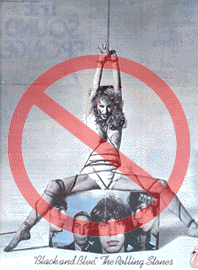
I was a little old for most of the nonsexist "Stories for Free Children" in every issue of Ms., but I liked the articles about women doing interesting, meaningful, courageous things, and fighting for legal and social equality. My favorite feature was the "No Comment" page at the back of every issue which featured some egregious bit of sexist advertising seen in magazines, newspapers, billboards or record covers. I'll never forget the photo of the giant billboard over Sunset Boulevard that advertised the 1976 album "Black and Blue" by the Rolling Stones. It featured a bound, gagged and bruised half-naked woman with the caption, "I'm 'Black and Blue' from the Rolling Stones — and I love it!" I found it revolting and ever since have been unable to hear the Stones' music without thinking of that or of the degrading, sexist and racist lyrics from their "Some Girls" album released two years later.
Mom also subscribed to Time and Life, Look and Smithsonian, and we enjoyed Vogue too, both for its fabulous fashion photography and also for its excellent articles on history and culture. For a time we even got a monthly magazine of sheet music. My dad and uncle tried to keep me from growing into a bourgeois suburbanite by sending me Ranger Rick children's nature magazines, but they were too young for me. Sweet as the photos were, captioned candid photos of raccoons at play couldn't compete with articles on the women's liberation movement or high fashion for this girl's interest. (The 1970s were particularly schizophrenic when it came to both objectifying and opening up opportunities for women.)
When my mom and I were at a hair salon I'd pick up magazines we didn't get at home, like Essence or Ebony, and enjoy the ads featuring black women advertising what seemed to white-bread little me to be exotic hair products. Most women's magazines of the time ignored black women almost completely, never mentioning anything about black hair care or makeup needs, nor using black (or Asian or Hispanic) models. When Iman and Beverly Johnson came along in the 1970s and their gorgeous African American faces started showing up in fashion magazines, they were groundbreaking.
My mother was a high school teacher and I attended the school at which she taught, so I often rode to or from school with her. While waiting for school to begin or while waiting for my ride home, I often hung out in the school library and sat near the long wall lined with bound issues of every issue of Time and Life magazine ever published. I plowed through decade after decade's worth of weekly newsmagazines, watching the progress of the Depression, World War II and the Cold War through articles and advertisements aimed at entertaining and uplifting those on the home front.
I enjoyed the ads especially: the breathless headlines; the startled faces of beautiful women in pearls and high heels deliriously caressing their new electric kitchen appliances; men in fedoras showing off their new Edsels and Studebakers; children attacking their ham steaks and tuna noodle casseroles with gusto. Products had names like Fluffo (yellow-dyed vegetable shortening) and Sta-Flo (liquid starch, to make shirts and aprons extra crisp, and extra scratchy).
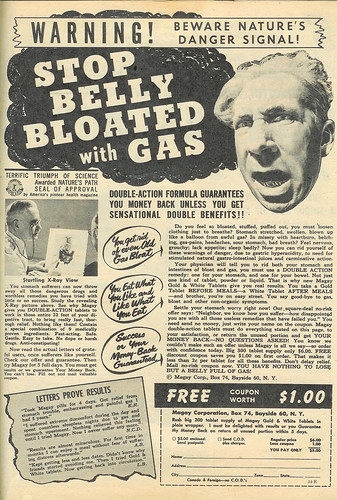
Illustrations from the twenties were full of angular Jazz Age characters. Issues from the thirties show a wistful worship of the silver screen stars who gave Depression-era readers something pretty to fantasize about as a distraction from their difficult lives. Magazines of the forties showed women in wide-shouldered, thin-hipped coats and dresses that mirrored the military preoccupation of the time and made them look better fit to take on the jobs of the men who'd gone off to war. Vividly tinted photos of the fifties featured images of ecstatic family members gathering joyfully around whatever modern miracle was on offer. In contrast to these rosy scenes of perfect suburban lives were occasional disturbing ads found in less reputable magazines featuring bouncing disembodied heads of characters meant to grab one's attention much like circus sideshow freaks would. Recipes of the fifties were more imaginative (and frightening) than the straight-laced dishes of the forties; a photo of fluffy pink-dyed cakes with boiled-sugar icing and bits of maraschino cherries floating in mile-high shortening-based filling remind me rather sickeningly of the olive loaf so popular with school-lunch-making housewives of the period.
My delight in vintage magazines has continued over the years. I've checked them out of libraries in California and Washington and used them extensively to research daily life from the 1920s through the 1950s. Not only do I have an embarrassing number of magazines subscriptions to this day, I also have a small but delightful collection of vintage magazines dating back to the 1920s. Last weekend I hit the jackpot with a cache of magazines from 1961 to 1970 I picked up at an estate sale, and I've been poring over the articles, ads, recipes and other reminders of the cultural preoccupations prevalent during my early childhood. The 1961 magazines (which predate me) feature articles on Princess Margaret's private life, romance novel excerpts, how to avoid overworking your minister's wife, and how to "play it cool" by being "the girl who looks and feels like the frosting on a glass in clothes that are strictly care-free." There is mention in Good Housekeeping's May 1961 issue of an oral contraceptive for dogs available by prescription from veterinarians on the same page as an article about finding jobs for young women: pert young ladies of the time could train to be engineering aides, nurses or stewardesses, and the article mentions that, importantly, none of these positions required a college education. (Why should a young woman bother with that when she could just give up her job once she earned was referred to as her M.R.S. degree anyway?)
Over the upcoming weeks I'll be choosing some of the most entertaining, enlightening and disturbing articles from these vintage treasures to share with you here in my blog. Stay tuned.
Nowadays most of my subscriptions are for fashion and shelter magazines; I use them as inspiration for my artwork and to keep abreast of design and fashion trends. During my childhood my mom and I read the standard middle-American women's magazines like McCall's, Family Circle, Ladies' Home Journal and Women's Day, but we also got every issue of Ms., the groundbreaking feminist magazine, from the very first issue. I enjoyed the monthly page of paper dolls included in every issue of McCall's, but from the time I was nine, I looked forward to Ms. magazine the most every month.
I was a little old for most of the nonsexist "Stories for Free Children" in every issue of Ms., but I liked the articles about women doing interesting, meaningful, courageous things, and fighting for legal and social equality. My favorite feature was the "No Comment" page at the back of every issue which featured some egregious bit of sexist advertising seen in magazines, newspapers, billboards or record covers. I'll never forget the photo of the giant billboard over Sunset Boulevard that advertised the 1976 album "Black and Blue" by the Rolling Stones. It featured a bound, gagged and bruised half-naked woman with the caption, "I'm 'Black and Blue' from the Rolling Stones — and I love it!" I found it revolting and ever since have been unable to hear the Stones' music without thinking of that or of the degrading, sexist and racist lyrics from their "Some Girls" album released two years later.
Mom also subscribed to Time and Life, Look and Smithsonian, and we enjoyed Vogue too, both for its fabulous fashion photography and also for its excellent articles on history and culture. For a time we even got a monthly magazine of sheet music. My dad and uncle tried to keep me from growing into a bourgeois suburbanite by sending me Ranger Rick children's nature magazines, but they were too young for me. Sweet as the photos were, captioned candid photos of raccoons at play couldn't compete with articles on the women's liberation movement or high fashion for this girl's interest. (The 1970s were particularly schizophrenic when it came to both objectifying and opening up opportunities for women.)
When my mom and I were at a hair salon I'd pick up magazines we didn't get at home, like Essence or Ebony, and enjoy the ads featuring black women advertising what seemed to white-bread little me to be exotic hair products. Most women's magazines of the time ignored black women almost completely, never mentioning anything about black hair care or makeup needs, nor using black (or Asian or Hispanic) models. When Iman and Beverly Johnson came along in the 1970s and their gorgeous African American faces started showing up in fashion magazines, they were groundbreaking.
My mother was a high school teacher and I attended the school at which she taught, so I often rode to or from school with her. While waiting for school to begin or while waiting for my ride home, I often hung out in the school library and sat near the long wall lined with bound issues of every issue of Time and Life magazine ever published. I plowed through decade after decade's worth of weekly newsmagazines, watching the progress of the Depression, World War II and the Cold War through articles and advertisements aimed at entertaining and uplifting those on the home front.
I enjoyed the ads especially: the breathless headlines; the startled faces of beautiful women in pearls and high heels deliriously caressing their new electric kitchen appliances; men in fedoras showing off their new Edsels and Studebakers; children attacking their ham steaks and tuna noodle casseroles with gusto. Products had names like Fluffo (yellow-dyed vegetable shortening) and Sta-Flo (liquid starch, to make shirts and aprons extra crisp, and extra scratchy).
Illustrations from the twenties were full of angular Jazz Age characters. Issues from the thirties show a wistful worship of the silver screen stars who gave Depression-era readers something pretty to fantasize about as a distraction from their difficult lives. Magazines of the forties showed women in wide-shouldered, thin-hipped coats and dresses that mirrored the military preoccupation of the time and made them look better fit to take on the jobs of the men who'd gone off to war. Vividly tinted photos of the fifties featured images of ecstatic family members gathering joyfully around whatever modern miracle was on offer. In contrast to these rosy scenes of perfect suburban lives were occasional disturbing ads found in less reputable magazines featuring bouncing disembodied heads of characters meant to grab one's attention much like circus sideshow freaks would. Recipes of the fifties were more imaginative (and frightening) than the straight-laced dishes of the forties; a photo of fluffy pink-dyed cakes with boiled-sugar icing and bits of maraschino cherries floating in mile-high shortening-based filling remind me rather sickeningly of the olive loaf so popular with school-lunch-making housewives of the period.
My delight in vintage magazines has continued over the years. I've checked them out of libraries in California and Washington and used them extensively to research daily life from the 1920s through the 1950s. Not only do I have an embarrassing number of magazines subscriptions to this day, I also have a small but delightful collection of vintage magazines dating back to the 1920s. Last weekend I hit the jackpot with a cache of magazines from 1961 to 1970 I picked up at an estate sale, and I've been poring over the articles, ads, recipes and other reminders of the cultural preoccupations prevalent during my early childhood. The 1961 magazines (which predate me) feature articles on Princess Margaret's private life, romance novel excerpts, how to avoid overworking your minister's wife, and how to "play it cool" by being "the girl who looks and feels like the frosting on a glass in clothes that are strictly care-free." There is mention in Good Housekeeping's May 1961 issue of an oral contraceptive for dogs available by prescription from veterinarians on the same page as an article about finding jobs for young women: pert young ladies of the time could train to be engineering aides, nurses or stewardesses, and the article mentions that, importantly, none of these positions required a college education. (Why should a young woman bother with that when she could just give up her job once she earned was referred to as her M.R.S. degree anyway?)
Over the upcoming weeks I'll be choosing some of the most entertaining, enlightening and disturbing articles from these vintage treasures to share with you here in my blog. Stay tuned.
Thursday, May 07, 2009
Laura's Assemblages on Display in Seattle Till July 15
From May 7 through July 15, thirty-three of my assemblages and paintings and a number of paintings by abstract painter Mary Bennet are on display in the Wachovia galleries on the 35th floor of Washington Mutual Tower in downtown Seattle. If you couldn’t make it to the opening but will be in Seattle some weekday before July 15, do arrange to see the art on a weekday afternoon by appointment with the very friendly and helpful Diana Slater. Just call Diana at (206) 344-6532 and she’ll be pleased so show you around. Many thanks to Diana and Spring Song Petta for their support and kindness, and to Wachovia for their sponsorship of this show.
For a sneak peek at my art, click here.
Sunday, April 19, 2009
The Book Borrowers
The Seattle Art Museum has acquired over a billion dollars' worth of new art within the last two years as a result of a recent expansion and redesign that proved to the world how seriously Seattle takes its art. The main museum was enlarged (and much of its charm removed) and SAM created a waterfront sculpture garden that has proved very popular. SAM and the related Seattle Asian Art Museum produce and host several worthy traveling shows annually. Another gem, Seattle's Frye Art Museum, presents not only its enjoyable permanent collection all year round (at no cost to visitors, even providing free parking) but also offers several smaller, well-curated exhibitions at any particular time. The very traditional 19th century mitteleuropean focus of the Frye's permanent collection at the museum's physical center is always a wonderful contrast to the quirky exhibitions that fill the outer galleries.
Seattle also has several gallery districts around town where one can see the work of hundreds of artists whose work hasn't made its way into many museums yet. Tacoma 45 minutes south has an enjoyable art museum just a five-minute walk from the popular Museum of Glass (and right near the excellent Washington State History Museum, which sometimes showcases art as well), so locals might wonder why they ought to cross Lake Washington from Seattle or drive up to the Eastside from Tacoma to go to the Bellevue Arts Museum, which is nestled in the middle of Bellevue's vast downtown shopping district, something for which the suburban stronghold is better known. What can the 'burbs offer that art-minded urbanites would find worth seeing?
Plenty. The Bellevue Arts Museum is different from other area art museums in that its focus is on design, craft and works that have often been considered less important than so-called fine art pieces. The permanent collection includes pieces by artists from the Northwest's famous Pilchuck Glass School, which was cofounded by Dale Chihuly in 1971, but most of the rest of the museum's galleries feature exhibitions devoted to particular artists, styles or media. Impressive past shows have revolved around beadwork, ceramics, quilts, furniture, kimonos, assemblage, calligraphy, woodworking, the even an assortment of teapots, both modern and historical. One currently featured exhibition, on view until June 14, is "The Book Borrowers: Contemporary Artists Transforming the Book." This impressive exhibition of altered book art features not only works by Northwest artists but also pieces by other artists from further afield.
The first thing to greet a visitor to the collection is a life-size sleeping Buddha carved out of phone books by artist Long-Bin Chen. They form half the body while a mirror below them reflects the books, seemingly creating a whole Buddha who levitates or floats serenely in a sea of glass. (See here how he turned Sotheby's auction house catalogs into a large Buddha head in another show.) Elsewhere in the gallery, works by Georgia Russell were created with the help of a scalpel with which Russell eviscerates books, cutting ribbons and tendrils out of them that rise up and out of the center of each volume. Particularly delightful are works by James Allen, who creates dozens of layers of illustrations cut out of books that rise up from the pages.
One of my favorite artists on display is Seattle's own Casey Curran, who builds remarkable works of books, paper, found objects and wire with hand cranks that set the works in motion. Sadly, visitors are warned not to touch his works on display at BAM, but you can see his work in action by clicking on his name above, or click here to see five of his pieces on YouTube. When his work was on display in Seattle's Gallery IMA last year, the gallery allowed visitors to touch the pieces, and I had the pleasure of cranking some of them myself, which made a horse gallop and anemones open and close, among other things.
Artist Jenn Khoshbin cuts concentric circles out of books and folds them back or removes them to expose and feature particular illustrations hidden within each book. She also makes pop-ups out of books that were never intended to contain them. Okinawa-born Yuken Teruya cuts exquisitely detailed and fragile tree shapes out of paper and creates miniature tree-dotted landscapes within books, which are, of course, made of trees. Guy Laramée creates entire ancient buildings seemingly carved into rock walls by sandblasting the insides of volumes. The show also features encyclopedias sandblasted impressively into a monumental landscape reminiscent of the Grand Canyon.
The artists in this show take the idea of finding whole words within books very literally, carving away, burning, folding, bending, gluing, cutting and coloring books created for entirely different purposes until they submit to the will of the artist and take on whole new meanings that their writers and publishers never even imagined.
This exhibition is part of "Material Evidence," BAM's ongoing series of internally organized exhibitions. As the BAM website puts it, "At the core of these artists’ poetics of the handmade, there is the constant investigation and reassessment of the mutual influence among concepts, materials and processes. During the creative process, these artists are often open to the new ways of thinking, feeling and creating as suggested by the material growth of the work. Touching, shaping, cutting, burning, sewing, carving, accumulating, removing are not simply ways to define the volumetric and formal aspects of the artwork, but also participate in shaping and giving substance to the meaning of it."
Seattle also has several gallery districts around town where one can see the work of hundreds of artists whose work hasn't made its way into many museums yet. Tacoma 45 minutes south has an enjoyable art museum just a five-minute walk from the popular Museum of Glass (and right near the excellent Washington State History Museum, which sometimes showcases art as well), so locals might wonder why they ought to cross Lake Washington from Seattle or drive up to the Eastside from Tacoma to go to the Bellevue Arts Museum, which is nestled in the middle of Bellevue's vast downtown shopping district, something for which the suburban stronghold is better known. What can the 'burbs offer that art-minded urbanites would find worth seeing?
Plenty. The Bellevue Arts Museum is different from other area art museums in that its focus is on design, craft and works that have often been considered less important than so-called fine art pieces. The permanent collection includes pieces by artists from the Northwest's famous Pilchuck Glass School, which was cofounded by Dale Chihuly in 1971, but most of the rest of the museum's galleries feature exhibitions devoted to particular artists, styles or media. Impressive past shows have revolved around beadwork, ceramics, quilts, furniture, kimonos, assemblage, calligraphy, woodworking, the even an assortment of teapots, both modern and historical. One currently featured exhibition, on view until June 14, is "The Book Borrowers: Contemporary Artists Transforming the Book." This impressive exhibition of altered book art features not only works by Northwest artists but also pieces by other artists from further afield.
The first thing to greet a visitor to the collection is a life-size sleeping Buddha carved out of phone books by artist Long-Bin Chen. They form half the body while a mirror below them reflects the books, seemingly creating a whole Buddha who levitates or floats serenely in a sea of glass. (See here how he turned Sotheby's auction house catalogs into a large Buddha head in another show.) Elsewhere in the gallery, works by Georgia Russell were created with the help of a scalpel with which Russell eviscerates books, cutting ribbons and tendrils out of them that rise up and out of the center of each volume. Particularly delightful are works by James Allen, who creates dozens of layers of illustrations cut out of books that rise up from the pages.
One of my favorite artists on display is Seattle's own Casey Curran, who builds remarkable works of books, paper, found objects and wire with hand cranks that set the works in motion. Sadly, visitors are warned not to touch his works on display at BAM, but you can see his work in action by clicking on his name above, or click here to see five of his pieces on YouTube. When his work was on display in Seattle's Gallery IMA last year, the gallery allowed visitors to touch the pieces, and I had the pleasure of cranking some of them myself, which made a horse gallop and anemones open and close, among other things.
Artist Jenn Khoshbin cuts concentric circles out of books and folds them back or removes them to expose and feature particular illustrations hidden within each book. She also makes pop-ups out of books that were never intended to contain them. Okinawa-born Yuken Teruya cuts exquisitely detailed and fragile tree shapes out of paper and creates miniature tree-dotted landscapes within books, which are, of course, made of trees. Guy Laramée creates entire ancient buildings seemingly carved into rock walls by sandblasting the insides of volumes. The show also features encyclopedias sandblasted impressively into a monumental landscape reminiscent of the Grand Canyon.
The artists in this show take the idea of finding whole words within books very literally, carving away, burning, folding, bending, gluing, cutting and coloring books created for entirely different purposes until they submit to the will of the artist and take on whole new meanings that their writers and publishers never even imagined.
This exhibition is part of "Material Evidence," BAM's ongoing series of internally organized exhibitions. As the BAM website puts it, "At the core of these artists’ poetics of the handmade, there is the constant investigation and reassessment of the mutual influence among concepts, materials and processes. During the creative process, these artists are often open to the new ways of thinking, feeling and creating as suggested by the material growth of the work. Touching, shaping, cutting, burning, sewing, carving, accumulating, removing are not simply ways to define the volumetric and formal aspects of the artwork, but also participate in shaping and giving substance to the meaning of it."
Monday, March 23, 2009
The World in Miniature
The Seattle Asian Art Museum (SAAM) in Volunteer Park is a beautiful Art Deco building that served as the main Seattle Art Museum for decades until the new one was built in downtown Seattle in the 1990s. SAM downtown has recently been renovated and received over a billion dollars worth of new art bequests and donations, so naturally it receives most of the national and international attention, but SAAM, the sister museum in Seattle's Capitol Hill neighborhood, is a real gem and always worth a visit. The setting of the park is wonderful; from Capitol Hill's main street, Broadway, the gay heart of the city, one meanders through narrow streets lined with grand and elegant Victorian homes to get there. Volunteer Park is a glorious urban retreat complete with walking trails, gorgeous views of the city and a lovely conservatory filled with thousands of species of plants.
Right next to the park is the gracious Lake View Cemetery, founded in 1873 and replete with late Victorian grave markers. Its greatest fame comes from being the final resting place of Bruce Lee and his son Brandon. During one visit to the cemetery several years ago, I came upon an Eastern European soccer team standing around his grave paying silent and serious homage, cigarettes and beer bottles in hand.
Last weekend my daughter and I made a special visit to SAAM to see an exhibition of watercolor paintings called "Garden & Cosmos: The Royal Paintings of Jodhpur." A traveling exhibition organized by the Smithsonian's Freer Gallery of Art and the Arthur M. Sackler Gallery, it first showed in Washington D.C., is in Seattle until April 26 and will move next to the British Museum from May 28 to August 23 and then to the National Museum of India in November. The exhibition was everything we'd hoped for: a large and exciting collection of 18th and 19th century paintings created for Indian royalty depicting maharajas, their homes and their wives and concubines; vast gardens filled with trees, flowers and animals; and dramatic tableaus featuring Hindu gods and holy men.
The level of detail was remarkable; impossibly detailed trees and saris were painted with infinitesimally fine lines and dots created with squirrel-tail brushes. Great care and love were lavished on works that included glorifications of Indian princes, paintings made in homage to particular gods, pieces created as aids to devotion and works created as visual histories or records of the grandeur of humans and deities alike. These paintings were never before displayed in public, and the sense of discovering something precious and jewel-like left almost unseen for so many years was thrilling.
I have always been a great fan of Indian miniature paintings with their tiny details, their lavish use of color and their energy and spirit. These paintings had all the elements of Indian miniatures, but were miniatures on a grand scale; that is, the scale of the detail in the paintings was the same as that found in miniature paintings, but these were expanded to fill pages of perhaps 15 by 30 inches rather than seven by nine, as one might expect for painting with this level of minuscule detail. The museum thoughtfully provided magnifying glasses to aid visitors in enjoying the works, many of which would be difficult for patrons with less than perfect vision to appreciate.
Being an artist who specializes in detailed, small-scale pieces, I have always been drawn to both admiring and creating works with a high degree of detail. In order to enjoy them, one must approach the works very closely and focus carefully; they require a level of intimacy unusual in fine art, and I love that. One has to get as close as possible to them to see what the artist wants us to see, until we're so close that the edges of the picture plane blur and disappear and we can imagine ourselves within that tiny world. They take greater effort to enjoy, but they pay back that effort with small surprises and hidden treasures.
This sort of care is usually lavished only on truly personal works of art, such as jewelry, which is worn on and warmed by the body, or in reliquaries holding relics of holy people (like saints) or things (like a piece of the "one true cross"), or in altars to Buddha or Hindu deities like my favorite, Ganesha, or in prayer books. The tradition of creating illuminated manuscripts has created similarly lavishly illustrated prayer books as aids to contemplation and devotion. Masterpieces of illumination like the Irish Book of Kells or the French Très Riches Heures de Jean, Duc de Berry are famous works of great art in their own right. And the art of illumination is not simply a Christian tradition; calligraphy is the premier art form of the Muslim world and one can find photos of thousands of exquisite illuminated pages from the Qur'an online; the Topkapi Palace collection is particularly fine. There are, of course, illuminated Jewish texts including versions of the Torah and the Haggadah as well, though sadly Jewish and Muslim manuscripts are rarely made mention of in Western books about the art of manuscript illumination.
Exquisite renderings of quotations from the Qur'an are an important element of Islamic art because of Islam's prohibition on illustrations featuring people or animals. The high degree of elegance and delicacy of detail in Muslim illuminated manuscripts and in decoration of mosques and other buildings in the Muslim comes largely from the necessity of perfecting the art of abstract illustration and a heavy reliance on the use of natural botanical forms as inspiration. Two years ago the Bellevue Arts Museum had an small but fine exhibition of works by contemporary Islamic calligrapher Mohamed Zakariya done in both classical and modern style.
The works in the "Gardens & Cosmos" exhibition feature tiny renderings of vast subjects, from gardens to palaces, from ocean to sky. It is ironic that such charmingly delicate illustrations can convey grand themes so beautifully.
Right next to the park is the gracious Lake View Cemetery, founded in 1873 and replete with late Victorian grave markers. Its greatest fame comes from being the final resting place of Bruce Lee and his son Brandon. During one visit to the cemetery several years ago, I came upon an Eastern European soccer team standing around his grave paying silent and serious homage, cigarettes and beer bottles in hand.
Last weekend my daughter and I made a special visit to SAAM to see an exhibition of watercolor paintings called "Garden & Cosmos: The Royal Paintings of Jodhpur." A traveling exhibition organized by the Smithsonian's Freer Gallery of Art and the Arthur M. Sackler Gallery, it first showed in Washington D.C., is in Seattle until April 26 and will move next to the British Museum from May 28 to August 23 and then to the National Museum of India in November. The exhibition was everything we'd hoped for: a large and exciting collection of 18th and 19th century paintings created for Indian royalty depicting maharajas, their homes and their wives and concubines; vast gardens filled with trees, flowers and animals; and dramatic tableaus featuring Hindu gods and holy men.
The level of detail was remarkable; impossibly detailed trees and saris were painted with infinitesimally fine lines and dots created with squirrel-tail brushes. Great care and love were lavished on works that included glorifications of Indian princes, paintings made in homage to particular gods, pieces created as aids to devotion and works created as visual histories or records of the grandeur of humans and deities alike. These paintings were never before displayed in public, and the sense of discovering something precious and jewel-like left almost unseen for so many years was thrilling.
I have always been a great fan of Indian miniature paintings with their tiny details, their lavish use of color and their energy and spirit. These paintings had all the elements of Indian miniatures, but were miniatures on a grand scale; that is, the scale of the detail in the paintings was the same as that found in miniature paintings, but these were expanded to fill pages of perhaps 15 by 30 inches rather than seven by nine, as one might expect for painting with this level of minuscule detail. The museum thoughtfully provided magnifying glasses to aid visitors in enjoying the works, many of which would be difficult for patrons with less than perfect vision to appreciate.
Being an artist who specializes in detailed, small-scale pieces, I have always been drawn to both admiring and creating works with a high degree of detail. In order to enjoy them, one must approach the works very closely and focus carefully; they require a level of intimacy unusual in fine art, and I love that. One has to get as close as possible to them to see what the artist wants us to see, until we're so close that the edges of the picture plane blur and disappear and we can imagine ourselves within that tiny world. They take greater effort to enjoy, but they pay back that effort with small surprises and hidden treasures.
This sort of care is usually lavished only on truly personal works of art, such as jewelry, which is worn on and warmed by the body, or in reliquaries holding relics of holy people (like saints) or things (like a piece of the "one true cross"), or in altars to Buddha or Hindu deities like my favorite, Ganesha, or in prayer books. The tradition of creating illuminated manuscripts has created similarly lavishly illustrated prayer books as aids to contemplation and devotion. Masterpieces of illumination like the Irish Book of Kells or the French Très Riches Heures de Jean, Duc de Berry are famous works of great art in their own right. And the art of illumination is not simply a Christian tradition; calligraphy is the premier art form of the Muslim world and one can find photos of thousands of exquisite illuminated pages from the Qur'an online; the Topkapi Palace collection is particularly fine. There are, of course, illuminated Jewish texts including versions of the Torah and the Haggadah as well, though sadly Jewish and Muslim manuscripts are rarely made mention of in Western books about the art of manuscript illumination.
Exquisite renderings of quotations from the Qur'an are an important element of Islamic art because of Islam's prohibition on illustrations featuring people or animals. The high degree of elegance and delicacy of detail in Muslim illuminated manuscripts and in decoration of mosques and other buildings in the Muslim comes largely from the necessity of perfecting the art of abstract illustration and a heavy reliance on the use of natural botanical forms as inspiration. Two years ago the Bellevue Arts Museum had an small but fine exhibition of works by contemporary Islamic calligrapher Mohamed Zakariya done in both classical and modern style.
The works in the "Gardens & Cosmos" exhibition feature tiny renderings of vast subjects, from gardens to palaces, from ocean to sky. It is ironic that such charmingly delicate illustrations can convey grand themes so beautifully.
Wednesday, March 04, 2009
The Quality of Mercy
"The quality of mercy is not strained.
It droppeth as the gentle rain from heaven
Upon the place beneath. It is twice blest:
It blesseth him that gives and him that takes."
—The Merchant of Venice, Act IV, Scene I
When I pass people who stand on freeway off-ramps with tatty cardboard signs begging for money, men and women with ravaged mouths and resigned eyes, I feel humble and grateful for my good fortune. It's often hard to look in their eyes and see the rawness of their lives. I try to smile or wave to show some acknowledgment, to let them know that they aren't invisible, that I recognize that they are human beings worthy of care.
Sometimes I roll down my window and give them a few bucks, wish them luck and hope things will get better for them soon. Occasionally I buy a few cheap hats or pairs of gloves and keep these in the car to offer to people asking for help. They are invariably polite and grateful, and some launch into stories that they have to cut short when the light changes and I have to drive away, so grateful are they to have someone look them in the eye and remind them that they're worthy of attention, instead of shouting at them to get a job or refusing to meet their eyes or acknowledge their existence.
I am aware that some people don't approve of giving money to people on the street, saying they'll just go out and buy drugs or alcohol with it, so it's no favor to them to enable dangerous behavior. Give directly to shelters or charities or soup kitchens, they say, which is of course a fine idea. But some donate to foundations not just because it's a good thing but because they believe it will force street people to stop pestering the rest of us and go inside where we won't have to look at them anymore.
Some say the homeless are just lazy creeps living easy lives off the largess of others, that being kind to them emboldens them to do wrong, that if they just got off their backsides and took a shower once in a while they could go get jobs and pay their own way instead of mooching off the rest of us. The people who say such things get angry and resentful when they see someone asking for money, or trying to sleep on a park bench, a cluster of ragged plastic bags full of odd possessions in a jumble next to them. Some are unwilling to help the destitute and quick to assume that they're bad people and liars, even actively wanting them to suffer for having the gall to ask for help directly from strangers.
Being a soft touch means being called upon for help more often, it's true. But it also means having more chances to show compassion and open-heartedness. It means believing that sometimes people change and turn their lives around, that even those among us who screw up still deserve compassion. It means showing faith and optimism and, as Gandhi put it, "[being] the change you want to see in the world." For many, doing a service for someone who is destitute and desperate is a way to do service unto their deity; as Jesus said, "Inasmuch as ye have done it unto one of the least of these my brethren, ye have done it unto me."
In January I saw an article in the online magazine Slate written by Patty and Sandy Stonesifer titled "Sister, Can You Spare a Dime?" The article (which was subtitled "I don't give to my neighborhood panhandlers. Should I?") was part of a series on philanthropy written for Slate, a publication for which Patty Stonesifer's husband, the liberal pundit and former editor of The New Republic, Michael Kinsley, was the founding editor. The Stonesifer sisters know more than a little about great wealth, philanthropy and social services. Patty Stonesifer was co-chair and CEO of the Bill and Melinda Gates Foundation for ten years. Before that she was senior VP of Microsoft's Interactive Media Division, and as far back as 1996 she was named one of the 25 Most Influential People in America by Time. Sandy Stonesifer is the project manager for a national study of the consequences of unintended pregnancy. Their father, Harry Stonesifer, was the CEO of Boeing until 2005.
In Slate Sandy wrote that she didn't give to panhandlers directly but to organizations that advocate for the homeless, and that she also bought the occasional sandwich for a homeless guy she sees regularly. She wrote, "If you feel compelled to give to someone directly, be honest with yourself that your action isn't really about ending homelessness—but more about reinforcing shared humanity." Her sister Patty wrote, "Sandy provides sandwiches, but I recommend not giving handouts. . . . My commute involves two different stoplights where I am sure to get asked for funds by homeless men, but I have to be honest: My car insulates me from their pain. Perhaps we would all do more about the issue if every one of us spent even a few seconds with homeless people each day. If the current economy is an indication, the numbers of people experiencing homelessness will grow in your community. . . . Avoid giving directly to the man or woman on the street—but do address him or her with the same human regard you give others in your path."
I was surprised that both sisters advised against helping people directly without saying why, but pleased when they recommended helping via social service agencies. Such organizations provide much-needed food, shelter, clothes, job opportunities, even places to receive mail and bathe. They showed concern for the feelings of the homeless and encouraged treating them with respect. What I was not prepared for were scathing comments from readers who chose to attack the homeless, calling them liars, users, dangerous and accusing them of all manner of ugly things. Some people adamantly stated opposition to helping people who had the temerity to debase themselves in public and risk humiliation by asking directly for handouts. Their excuse for refusing help was the possibility that people who are asking for aid would use the money to buy drugs or alcohol. They accused those who fund beggars of worsening the problem of public drug addiction and alcoholism.
First of all, these are human beings. Most are not asking for money because it is easier than working; they are asking for it because they can't find or keep jobs. If you have no home, no phone, no regular address at which to receive mail, no clean clothes and, probably, few marketable skills, how likely are you to get work in any economic climate, let alone the current horrible one? And if you're on the street there's a good chance you have an alcohol or drug problem so severe you can't easily kick it without a good support system. You also have a high likelihood of suffering from some type of severe emotional or mental disturbance. You feel physically ill a lot, people mug you, steal your stuff, may try to rape you and they probably revile you; the only thing that makes you feel better for even a little bit of each day is sleep and a bit of the substance that's helped to wreck your life.
So, let's say you're homeless, you're hurting, you're humiliated and you probably know you've done a lot to put yourself into that position. You've screwed up big-time. You don't believe in yourself or your ability to fix your life anymore. If you've got an addiction, which is quite possible, how likely are you to want to give it up when you know that doing so would make you feel intensely sick for several days, and then you'd feel extreme psychological cravings for months or years afterwards? And that's only if you're one of the few addicts lucky enough to be able to quit in the first place while living without a stable home and a good support system. And how likely is it that you'll be able to turn yourself around if the people who pass you on the street tell you that you're garbage?
Shelters fill up early every day, they have loud, mentally unbalanced people roaming around who make noise all night, sometimes stealing others' belongings, and shelters are breeding grounds for tuberculosis and other dangerous communicable diseases. They usually kick inhabitants out early in the day. Some missions make homeless people listen to sermons about how their only hope is to recognize how horrible they and their lives are before they can eat or lie down. How likely would you be to want to spend time in such a place?
If you only have a dollar a week to spend on helping the homeless, should you give it to some guy on the corner who's shaking and on the verge of delirium tremens or to an organization that helps the homeless? Of course supporting local homeless shelters, food banks, job training organizations or other groups that benefit the destitute is a wonderful idea and the best place to start. If you can only afford a little bit, sure, put your money toward a good organization. But if you have enough money that you buy a few coffees or a chai or a few Diet Cokes each week just for fun, maybe you could afford another few dollars to help one or two people for whom $5 is a major windfall? Can't we do a bit of both and give a few bucks to the woman on the corner and to the local women's shelter, too?
Giving directly to someone on the street puts a face on a kind deed and lets you look someone in the eye and remind that person that another human being thinks he or she is worthy of hope and help. Small acts of compassion can be stepping stones that remind others to believe in the goodness of others and to pass on that act of compassion to someone else. And many homeless people do help those around them. They keep track of other folks, share food and look after friends' belongings, help them find a new coat when one is stolen or get them to a clinic when they're sick. Just because people find themselves, often because of their foolish actions, in extreme situations doesn't mean they should have to give up all dignity or that they've lost the right to ask for help.
Some people are so afraid of being lied to or conned that they'd rather not help anyone or show any mercy than risk being kind to someone who doesn't deserve it. They find the idea of believing too much in the worth of other people so frightening and embarrassing that they'd rather turn their hearts away from everyone to avoid inadvertently helping someone undeserving. Where there is mercy, sometimes there will be those who take advantage. That is the cost of a civil society. When you give people the benefit of the doubt and presume them innocent instead of guilty, sometimes the bad go free while the hard-working make their donations or pay their taxes to fund people who are happy to take advantage of others. It happens occasionally; it's unfair. But isn't it better to have a little less and know that you made a positive effort, showed mercy and set a good example for others than to have a little more because you locked away your money and your heart and ignored the humanity of the less appealing among us?
Sometimes I give money to people who almost certainly spend it on drugs or alcohol instead of food. I've not seen it, but clearly some of the people I give to have suffered severe physical problems because they've neglected or actively undermined their health. Sometimes I've bought or given them food instead of money when the situation seemed safe; other times I figured I'd rather they get what they need from me honestly than that they feel compelled to take money or other things by force from others to find money to feed their habits. I'd rather they see that if they ask for help, there are people who value them enough to give it. If their lives are so awful that the only thing that makes them feel okay is a shot of vodka or a vial of crack, my little donation isn't likely to buy enough to kill them but it might be enough to give comfort and keep them from selling themselves or staying out late in bad neighborhoods trying to gather more money. Maybe they won't pass on an STD to someone else that night because they don't have to share a needle or service a stranger to get enough money to buy their drugs.
There are users, losers, screw-ups. Many are addled due to drugs or drink; some aren't that bright to begin with. There are people like that living in any middle-class neighborhood, too. But among the homeless many have mental problems and a disturbingly high percentage have been manhandled and abused while in the custody of foster care, mental hospitals, veterans' hospitals. Some started out full of promise but broke down along the way and lost track of reality enough that they couldn't or wouldn't ask for help from more appropriate sources anymore. Each one was somebody's baby once.
Homeless people who take my money always thank me, usually bless me, and often tell me a little something about themselves, how they got to be where they are, or how they're hoping to get off the street. They look at me directly and earnestly and want to say how much it means to them to receive a smile, a few bucks, acknowledgment. It's not that they don't miss their dignity; they've just been made to feel that it's a luxury they can no longer afford. Give it back to them and, despite all the dishonor and disgust they've experienced all day long, they are eager to give respect and kindness in return. Giving to them gives them hope, and it gives me hope, too.
It droppeth as the gentle rain from heaven
Upon the place beneath. It is twice blest:
It blesseth him that gives and him that takes."
—The Merchant of Venice, Act IV, Scene I
When I pass people who stand on freeway off-ramps with tatty cardboard signs begging for money, men and women with ravaged mouths and resigned eyes, I feel humble and grateful for my good fortune. It's often hard to look in their eyes and see the rawness of their lives. I try to smile or wave to show some acknowledgment, to let them know that they aren't invisible, that I recognize that they are human beings worthy of care.
Sometimes I roll down my window and give them a few bucks, wish them luck and hope things will get better for them soon. Occasionally I buy a few cheap hats or pairs of gloves and keep these in the car to offer to people asking for help. They are invariably polite and grateful, and some launch into stories that they have to cut short when the light changes and I have to drive away, so grateful are they to have someone look them in the eye and remind them that they're worthy of attention, instead of shouting at them to get a job or refusing to meet their eyes or acknowledge their existence.
I am aware that some people don't approve of giving money to people on the street, saying they'll just go out and buy drugs or alcohol with it, so it's no favor to them to enable dangerous behavior. Give directly to shelters or charities or soup kitchens, they say, which is of course a fine idea. But some donate to foundations not just because it's a good thing but because they believe it will force street people to stop pestering the rest of us and go inside where we won't have to look at them anymore.
Some say the homeless are just lazy creeps living easy lives off the largess of others, that being kind to them emboldens them to do wrong, that if they just got off their backsides and took a shower once in a while they could go get jobs and pay their own way instead of mooching off the rest of us. The people who say such things get angry and resentful when they see someone asking for money, or trying to sleep on a park bench, a cluster of ragged plastic bags full of odd possessions in a jumble next to them. Some are unwilling to help the destitute and quick to assume that they're bad people and liars, even actively wanting them to suffer for having the gall to ask for help directly from strangers.
Being a soft touch means being called upon for help more often, it's true. But it also means having more chances to show compassion and open-heartedness. It means believing that sometimes people change and turn their lives around, that even those among us who screw up still deserve compassion. It means showing faith and optimism and, as Gandhi put it, "[being] the change you want to see in the world." For many, doing a service for someone who is destitute and desperate is a way to do service unto their deity; as Jesus said, "Inasmuch as ye have done it unto one of the least of these my brethren, ye have done it unto me."
In January I saw an article in the online magazine Slate written by Patty and Sandy Stonesifer titled "Sister, Can You Spare a Dime?" The article (which was subtitled "I don't give to my neighborhood panhandlers. Should I?") was part of a series on philanthropy written for Slate, a publication for which Patty Stonesifer's husband, the liberal pundit and former editor of The New Republic, Michael Kinsley, was the founding editor. The Stonesifer sisters know more than a little about great wealth, philanthropy and social services. Patty Stonesifer was co-chair and CEO of the Bill and Melinda Gates Foundation for ten years. Before that she was senior VP of Microsoft's Interactive Media Division, and as far back as 1996 she was named one of the 25 Most Influential People in America by Time. Sandy Stonesifer is the project manager for a national study of the consequences of unintended pregnancy. Their father, Harry Stonesifer, was the CEO of Boeing until 2005.
In Slate Sandy wrote that she didn't give to panhandlers directly but to organizations that advocate for the homeless, and that she also bought the occasional sandwich for a homeless guy she sees regularly. She wrote, "If you feel compelled to give to someone directly, be honest with yourself that your action isn't really about ending homelessness—but more about reinforcing shared humanity." Her sister Patty wrote, "Sandy provides sandwiches, but I recommend not giving handouts. . . . My commute involves two different stoplights where I am sure to get asked for funds by homeless men, but I have to be honest: My car insulates me from their pain. Perhaps we would all do more about the issue if every one of us spent even a few seconds with homeless people each day. If the current economy is an indication, the numbers of people experiencing homelessness will grow in your community. . . . Avoid giving directly to the man or woman on the street—but do address him or her with the same human regard you give others in your path."
I was surprised that both sisters advised against helping people directly without saying why, but pleased when they recommended helping via social service agencies. Such organizations provide much-needed food, shelter, clothes, job opportunities, even places to receive mail and bathe. They showed concern for the feelings of the homeless and encouraged treating them with respect. What I was not prepared for were scathing comments from readers who chose to attack the homeless, calling them liars, users, dangerous and accusing them of all manner of ugly things. Some people adamantly stated opposition to helping people who had the temerity to debase themselves in public and risk humiliation by asking directly for handouts. Their excuse for refusing help was the possibility that people who are asking for aid would use the money to buy drugs or alcohol. They accused those who fund beggars of worsening the problem of public drug addiction and alcoholism.
First of all, these are human beings. Most are not asking for money because it is easier than working; they are asking for it because they can't find or keep jobs. If you have no home, no phone, no regular address at which to receive mail, no clean clothes and, probably, few marketable skills, how likely are you to get work in any economic climate, let alone the current horrible one? And if you're on the street there's a good chance you have an alcohol or drug problem so severe you can't easily kick it without a good support system. You also have a high likelihood of suffering from some type of severe emotional or mental disturbance. You feel physically ill a lot, people mug you, steal your stuff, may try to rape you and they probably revile you; the only thing that makes you feel better for even a little bit of each day is sleep and a bit of the substance that's helped to wreck your life.
So, let's say you're homeless, you're hurting, you're humiliated and you probably know you've done a lot to put yourself into that position. You've screwed up big-time. You don't believe in yourself or your ability to fix your life anymore. If you've got an addiction, which is quite possible, how likely are you to want to give it up when you know that doing so would make you feel intensely sick for several days, and then you'd feel extreme psychological cravings for months or years afterwards? And that's only if you're one of the few addicts lucky enough to be able to quit in the first place while living without a stable home and a good support system. And how likely is it that you'll be able to turn yourself around if the people who pass you on the street tell you that you're garbage?
Shelters fill up early every day, they have loud, mentally unbalanced people roaming around who make noise all night, sometimes stealing others' belongings, and shelters are breeding grounds for tuberculosis and other dangerous communicable diseases. They usually kick inhabitants out early in the day. Some missions make homeless people listen to sermons about how their only hope is to recognize how horrible they and their lives are before they can eat or lie down. How likely would you be to want to spend time in such a place?
If you only have a dollar a week to spend on helping the homeless, should you give it to some guy on the corner who's shaking and on the verge of delirium tremens or to an organization that helps the homeless? Of course supporting local homeless shelters, food banks, job training organizations or other groups that benefit the destitute is a wonderful idea and the best place to start. If you can only afford a little bit, sure, put your money toward a good organization. But if you have enough money that you buy a few coffees or a chai or a few Diet Cokes each week just for fun, maybe you could afford another few dollars to help one or two people for whom $5 is a major windfall? Can't we do a bit of both and give a few bucks to the woman on the corner and to the local women's shelter, too?
Giving directly to someone on the street puts a face on a kind deed and lets you look someone in the eye and remind that person that another human being thinks he or she is worthy of hope and help. Small acts of compassion can be stepping stones that remind others to believe in the goodness of others and to pass on that act of compassion to someone else. And many homeless people do help those around them. They keep track of other folks, share food and look after friends' belongings, help them find a new coat when one is stolen or get them to a clinic when they're sick. Just because people find themselves, often because of their foolish actions, in extreme situations doesn't mean they should have to give up all dignity or that they've lost the right to ask for help.
Some people are so afraid of being lied to or conned that they'd rather not help anyone or show any mercy than risk being kind to someone who doesn't deserve it. They find the idea of believing too much in the worth of other people so frightening and embarrassing that they'd rather turn their hearts away from everyone to avoid inadvertently helping someone undeserving. Where there is mercy, sometimes there will be those who take advantage. That is the cost of a civil society. When you give people the benefit of the doubt and presume them innocent instead of guilty, sometimes the bad go free while the hard-working make their donations or pay their taxes to fund people who are happy to take advantage of others. It happens occasionally; it's unfair. But isn't it better to have a little less and know that you made a positive effort, showed mercy and set a good example for others than to have a little more because you locked away your money and your heart and ignored the humanity of the less appealing among us?
Sometimes I give money to people who almost certainly spend it on drugs or alcohol instead of food. I've not seen it, but clearly some of the people I give to have suffered severe physical problems because they've neglected or actively undermined their health. Sometimes I've bought or given them food instead of money when the situation seemed safe; other times I figured I'd rather they get what they need from me honestly than that they feel compelled to take money or other things by force from others to find money to feed their habits. I'd rather they see that if they ask for help, there are people who value them enough to give it. If their lives are so awful that the only thing that makes them feel okay is a shot of vodka or a vial of crack, my little donation isn't likely to buy enough to kill them but it might be enough to give comfort and keep them from selling themselves or staying out late in bad neighborhoods trying to gather more money. Maybe they won't pass on an STD to someone else that night because they don't have to share a needle or service a stranger to get enough money to buy their drugs.
There are users, losers, screw-ups. Many are addled due to drugs or drink; some aren't that bright to begin with. There are people like that living in any middle-class neighborhood, too. But among the homeless many have mental problems and a disturbingly high percentage have been manhandled and abused while in the custody of foster care, mental hospitals, veterans' hospitals. Some started out full of promise but broke down along the way and lost track of reality enough that they couldn't or wouldn't ask for help from more appropriate sources anymore. Each one was somebody's baby once.
Homeless people who take my money always thank me, usually bless me, and often tell me a little something about themselves, how they got to be where they are, or how they're hoping to get off the street. They look at me directly and earnestly and want to say how much it means to them to receive a smile, a few bucks, acknowledgment. It's not that they don't miss their dignity; they've just been made to feel that it's a luxury they can no longer afford. Give it back to them and, despite all the dishonor and disgust they've experienced all day long, they are eager to give respect and kindness in return. Giving to them gives them hope, and it gives me hope, too.
Saturday, February 14, 2009
The Juliet Letters
Thank you for the flowers
I threw them on the fire
And I burned the photographs that you had enclosed
God they were ugly children
So you're the little bastard of that brother of mine
Trying to trick a poor old woman
'Til I almost had a weakness
So begins "I Almost Had a Weakness," a darkly amusing and arresting element of The Juliet Letters, a song cycle written and performed by Elvis Costello and the Brodsky Quartet in 1993. This album has long been one of my favorites among Costello's dozens of excellent and occasionally superlative albums released since the late 1970s. The Juliet Letters is the subject of an enjoyable hour-long documentary (available via Netflix) in which the musicians talk about the process of writing and performing the pieces and during which many of the pieces are performed.
The Juliet Letters song cycle was recently adapted into a theater piece complete with a narrative to hold the pieces together. The songs, each written in the form of a different kind of letter, are strong and beautiful enough to stand on their own without having some artificial thread strung between them in an attempt to make them more powerful or accessible. It is hard to think of a composer of popular music who writes more accessible melodies or more arresting hooks than Elvis Costello, and the combination of his plaintive voice and the masterful playing by the Brodsky Quartet, by turns swooning, insistent, humorous and angry, makes for a powerful work of art. Each song is like a new scene in a stage play, or like a whole play unto itself: a letter from a female soldier fearing that she won't live to return home; a letter from a law office reducing a highly emotional breakup to a legal document; a letter of disinheritance from a half-mad aunt to the relatives she suspects are out to take her for her money; even a chain-letter-style Faustian come-on:
Don't send any money!
Fate has no price
Ignore at your peril this splendid advice
An invaluable link in an infinite chain
An offer like this will just not come again . . .
Would I lie to you?
Would I sell you a dud?
Just sign on the line.
Could you possibly write it in blood?
Each is written in a different musical style appropriate to the text and the feeling of the song. The range of feelings and styles is wide and satisfying. For example, "Who Do You Think You Are?" is an insulting letter written to expose the foibles of an ex-lover. Costello's trademarked snide and sneeringly eviscerative style are very much in evidence here:
The hunted look, the haunted grace
The empty laugh that you cultivate
You fall into that false embrace
And kiss the air about her face
Who do you think you are?
The très bon mots you almost quote from your quiver of literary darts
A thousand or so tuneless violins thrilling your cheap little heart
Who do you think you are?
The Juliet Letters song cycle was recently adapted into a theater piece complete with a narrative to hold the pieces together. The songs, each written in the form of a different kind of letter, are strong and beautiful enough to stand on their own without having some artificial thread strung between them in an attempt to make them more powerful or accessible. It is hard to think of a composer of popular music who writes more accessible melodies or more arresting hooks than Elvis Costello, and the combination of his plaintive voice and the masterful playing by the Brodsky Quartet, by turns swooning, insistent, humorous and angry, makes for a powerful work of art. Each song is like a new scene in a stage play, or like a whole play unto itself: a letter from a female soldier fearing that she won't live to return home; a letter from a law office reducing a highly emotional breakup to a legal document; a letter of disinheritance from a half-mad aunt to the relatives she suspects are out to take her for her money; even a chain-letter-style Faustian come-on:
Don't send any money!
Fate has no price
Ignore at your peril this splendid advice
An invaluable link in an infinite chain
An offer like this will just not come again . . .
Would I lie to you?
Would I sell you a dud?
Just sign on the line.
Could you possibly write it in blood?
Each is written in a different musical style appropriate to the text and the feeling of the song. The range of feelings and styles is wide and satisfying. For example, "Who Do You Think You Are?" is an insulting letter written to expose the foibles of an ex-lover. Costello's trademarked snide and sneeringly eviscerative style are very much in evidence here:
The hunted look, the haunted grace
The empty laugh that you cultivate
You fall into that false embrace
And kiss the air about her face
Who do you think you are?
The très bon mots you almost quote from your quiver of literary darts
A thousand or so tuneless violins thrilling your cheap little heart
Who do you think you are?
Though he started out as one of New Wave music's premier Angry Young Men, Costello has always had a melodic bent and a brilliant ear for ballads like his first big hit, "Alison," as well as for driving, powerful rock anthems like "Pump It Up." His beautiful but half-ravaged voice, alternately brooding, cooing, wailing and pleading, is put to fine use in the darkly witty, sarcastic, spot-on observations and insights of his pop and rock works. In The Juliet Letters he further proves his versatility and shows himself capable of creating art songs in a pop-infused style that was surely influenced by the brilliant, dark and heartbreakingly beautiful popular art songs of Kurt Weill and Bertolt Brecht found in works such as The Threepenny Opera.
Wednesday, February 04, 2009
This Year's Crop of Oscar Nominees, Part Two
This is part two of my essay on some of the more interesting films to be nominated for Oscars at this year's upcoming Academy Awards ceremony. For part one, scroll down.
Tropic Thunder and The Dark Knight
Dumb and offensive as so much of "Tropic Thunder" is (albeit purposely), it is often hilarious, largely thanks to Robert Downey Jr. His all-out, over-the-top turn as a know-nothing, over-earnest, blue-eyed blond Australian movie star playing an African-American soldier in blackface is so outrageously bold that he deserves his Oscar nomination for this performance. Will he win? Probably not, since he's up against the late, great Heath Ledger, whose portrayal of the Joker in "The Dark Knight" blew so many people away. These performances show two excellent actors reinventing themselves to create compelling and palpable characters out of what could have been nothing but cartoons. One is so dark and foul that he frightens us by showing the darkness within us that we'd prefer never to face, and the other so light and lacking in self-awareness that he makes us laugh with his foolish buoyancy.
Despite his disappointing movement toward conservative politics, which he says was inspired by having spent time in prison for breaking drug laws, Hollywood loves Robert Downey Jr. He is popular not only for his extraordinary talent but also for his self-reinvention, personal redemption, and willingness to take responsibility for formerly bad behavior. He is now healthy and successful and, fates willing, will have many more years in which to prove himself worthy of continuing accolades. The fact that we've lost Heath Ledger forever in the bright prime of his youth, and just a few years after he lost a best actor nod for his uncanny portrayal of Ennis in "Brokeback Mountain" to (the very worthy) Philip Seymour Hoffman for his role in "Capote," means the Academy of Motion Picture Arts and Sciences will be looking for whatever chance they can get to lionize the fallen hero and remember Ledger with an Oscar.
Revolutionary Road
Combining the talents of actors Kate Winslet and Leonardo di Caprio with that of director Sam Mendes sounded like a wonderful idea, and the intense trailers for "Revolutionary Road" certainly captured my attention and drew me in. And yes, the performances were moving, disturbing and impressive. But the looming darkness of the film, the tension and painful payoff combined to produce a story essentially without redemption, a hopeless reminder of a time of stifled longings, needs and dreams. While it is very good, it still left me feeling like it could have been just a bit better, and the tragic arc of the story left me feeling depleted and sad enough that I walked out of the cinema rather sorry that I'd seen it.
Mendes doesn't shy away from tragedy or darkness. "American Beauty" opens with a voiceover announcing that the protagonist, Lester Burnham, is about to die, and we follow him down that road and end up exactly where we are warned we will. Yet the eventual death comes at the moment of Lester's dawning awareness and compassion, a moment when he is so full of love as to feel complete, so that, horrifying as his end appears to be, he dies contented and enlightened and having stopped himself from doing someone harm. We see meaning in his life and hope for several (though not all) of the characters left in his wake. And as dark and menacing as Mendes's film "The Road to Perdition" was, I still found a faint glimmer of hope in its ending, some understanding among the primary characters of why their lives had to follow the paths that they did. Badness was snuffed out, and a key character finds a better life. It is a bleak film, but beautiful, powerful and not completely crushing in my view, though I know many people found it too dark and difficult to enjoy as much as I did.
"Revolutionary Road," however, left a dark, sad spot in my heart, though it did reinforce my convictions regarding the vital importance of the fight for women's rights that took place in the two decades after the period in which the film takes place. The tightly controlled and judgmental values of the 1950s and early 1960s were indeed stifling and chilling to millions of men and women; for other excellent fictional accounts of the stultifying limitations on personal freedoms prevalent at this time, see Imelda Staunton's powerful performance in the Mike Leigh film "Vera Drake" or watch the terrific television show "Mad Men." It's no wonder American society had such a narcissistic and uninhibited overreaction to such mores in the decades following.
"Revolutionary Road" is a fine film, but I did not find it as strong as most of Mendes's earlier work; the clashes between characters felt stagy and talky, and the angst was too outward and obvious. I would have liked to see a bit more simmering and a bit less of a rolling boil going so much of the time. As much as I admire the acting of the wonderful Ms. Winslet, who is director Sam Mendes's real-life wife, I thought this played to her weakness, which is an overearnest shrewishness which several of her roles fall into. I blame Mendes more than Winslet in this case; I wish he'd asked her to show more of the subtlety that she's capable of. The arguments between her character and di Caprio's either had to get uglier or more subtle than they did for me to really believe in their exchanges. Although she's getting more attention for this film than Leo is, I thought di Caprio's performance was subtler and more interesting in many ways; watching his revulsion over his missteps made me queasy in sympathy, as well as vaguely disgusted by his weakness.
WALL•E and the Soundtracks of Thomas Newman
WALL•E is of course a shoo-on for the best animated feature film Oscar. A funny, beautiful and touching film, it transcends animation gimmickry and stands on its own as a delightful piece of film-making. The only question is whether it was fair to leave it out of the "Best Picture" category, it's so good. Happily, having it completely outclass the other entries in the animated feature category guarantees it the big-deal Oscar it deserves. It will probably win a variety of other technical Oscars and the best original song award for the beautiful tune "Down to Earth" which was written by Peter Gabriel and Thomas Newman. The song is sung by Peter Gabriel during the credits. I also loved the songs A.R. Rahman wrote for "Slumdog Millionaire," however, and think they added significantly to the power of the film. Whichever of these songs wins, I'll be satisfied.
I'm mad for the soundtrack work of Thomas Newman, who scored "American Beauty," "The Road to Perdition," "Six Feet Under," "The Shawshank Redemption" and "Jarhead," among many other films. His shimmering, jangling, quirkily dark pieces use surprising rhythms and unexpected instrumentation. He moves from unusual synthesized sounds to rich orchestral strings, incorporates piercing oboes, simple but effectively repetitive acoustic piano lines and multiple strummed guitars. All of it is percussive and rich with mysterious aural pleasures. He uses layers of strings to build up to painful climaxes sometimes held almost to the breaking point before resolving. Newman's work is distinctive, easily recognizable, heartbreakingly moving.
Newman is the cousin of singer and songwriter Randy Newman, a renowned film composer in his own right, nominated for 17 Oscars and winner of one (so far). The Newmans are part of a musical dynasty: Thomas is also the son of legendary and prolific film composer Alfred Newman, the nephew of composers Lionel and Emil Newman, and brother to David Newman.
Tropic Thunder and The Dark Knight
Dumb and offensive as so much of "Tropic Thunder" is (albeit purposely), it is often hilarious, largely thanks to Robert Downey Jr. His all-out, over-the-top turn as a know-nothing, over-earnest, blue-eyed blond Australian movie star playing an African-American soldier in blackface is so outrageously bold that he deserves his Oscar nomination for this performance. Will he win? Probably not, since he's up against the late, great Heath Ledger, whose portrayal of the Joker in "The Dark Knight" blew so many people away. These performances show two excellent actors reinventing themselves to create compelling and palpable characters out of what could have been nothing but cartoons. One is so dark and foul that he frightens us by showing the darkness within us that we'd prefer never to face, and the other so light and lacking in self-awareness that he makes us laugh with his foolish buoyancy.
Despite his disappointing movement toward conservative politics, which he says was inspired by having spent time in prison for breaking drug laws, Hollywood loves Robert Downey Jr. He is popular not only for his extraordinary talent but also for his self-reinvention, personal redemption, and willingness to take responsibility for formerly bad behavior. He is now healthy and successful and, fates willing, will have many more years in which to prove himself worthy of continuing accolades. The fact that we've lost Heath Ledger forever in the bright prime of his youth, and just a few years after he lost a best actor nod for his uncanny portrayal of Ennis in "Brokeback Mountain" to (the very worthy) Philip Seymour Hoffman for his role in "Capote," means the Academy of Motion Picture Arts and Sciences will be looking for whatever chance they can get to lionize the fallen hero and remember Ledger with an Oscar.
Revolutionary Road
Combining the talents of actors Kate Winslet and Leonardo di Caprio with that of director Sam Mendes sounded like a wonderful idea, and the intense trailers for "Revolutionary Road" certainly captured my attention and drew me in. And yes, the performances were moving, disturbing and impressive. But the looming darkness of the film, the tension and painful payoff combined to produce a story essentially without redemption, a hopeless reminder of a time of stifled longings, needs and dreams. While it is very good, it still left me feeling like it could have been just a bit better, and the tragic arc of the story left me feeling depleted and sad enough that I walked out of the cinema rather sorry that I'd seen it.
Mendes doesn't shy away from tragedy or darkness. "American Beauty" opens with a voiceover announcing that the protagonist, Lester Burnham, is about to die, and we follow him down that road and end up exactly where we are warned we will. Yet the eventual death comes at the moment of Lester's dawning awareness and compassion, a moment when he is so full of love as to feel complete, so that, horrifying as his end appears to be, he dies contented and enlightened and having stopped himself from doing someone harm. We see meaning in his life and hope for several (though not all) of the characters left in his wake. And as dark and menacing as Mendes's film "The Road to Perdition" was, I still found a faint glimmer of hope in its ending, some understanding among the primary characters of why their lives had to follow the paths that they did. Badness was snuffed out, and a key character finds a better life. It is a bleak film, but beautiful, powerful and not completely crushing in my view, though I know many people found it too dark and difficult to enjoy as much as I did.
"Revolutionary Road," however, left a dark, sad spot in my heart, though it did reinforce my convictions regarding the vital importance of the fight for women's rights that took place in the two decades after the period in which the film takes place. The tightly controlled and judgmental values of the 1950s and early 1960s were indeed stifling and chilling to millions of men and women; for other excellent fictional accounts of the stultifying limitations on personal freedoms prevalent at this time, see Imelda Staunton's powerful performance in the Mike Leigh film "Vera Drake" or watch the terrific television show "Mad Men." It's no wonder American society had such a narcissistic and uninhibited overreaction to such mores in the decades following.
"Revolutionary Road" is a fine film, but I did not find it as strong as most of Mendes's earlier work; the clashes between characters felt stagy and talky, and the angst was too outward and obvious. I would have liked to see a bit more simmering and a bit less of a rolling boil going so much of the time. As much as I admire the acting of the wonderful Ms. Winslet, who is director Sam Mendes's real-life wife, I thought this played to her weakness, which is an overearnest shrewishness which several of her roles fall into. I blame Mendes more than Winslet in this case; I wish he'd asked her to show more of the subtlety that she's capable of. The arguments between her character and di Caprio's either had to get uglier or more subtle than they did for me to really believe in their exchanges. Although she's getting more attention for this film than Leo is, I thought di Caprio's performance was subtler and more interesting in many ways; watching his revulsion over his missteps made me queasy in sympathy, as well as vaguely disgusted by his weakness.
WALL•E and the Soundtracks of Thomas Newman
WALL•E is of course a shoo-on for the best animated feature film Oscar. A funny, beautiful and touching film, it transcends animation gimmickry and stands on its own as a delightful piece of film-making. The only question is whether it was fair to leave it out of the "Best Picture" category, it's so good. Happily, having it completely outclass the other entries in the animated feature category guarantees it the big-deal Oscar it deserves. It will probably win a variety of other technical Oscars and the best original song award for the beautiful tune "Down to Earth" which was written by Peter Gabriel and Thomas Newman. The song is sung by Peter Gabriel during the credits. I also loved the songs A.R. Rahman wrote for "Slumdog Millionaire," however, and think they added significantly to the power of the film. Whichever of these songs wins, I'll be satisfied.
I'm mad for the soundtrack work of Thomas Newman, who scored "American Beauty," "The Road to Perdition," "Six Feet Under," "The Shawshank Redemption" and "Jarhead," among many other films. His shimmering, jangling, quirkily dark pieces use surprising rhythms and unexpected instrumentation. He moves from unusual synthesized sounds to rich orchestral strings, incorporates piercing oboes, simple but effectively repetitive acoustic piano lines and multiple strummed guitars. All of it is percussive and rich with mysterious aural pleasures. He uses layers of strings to build up to painful climaxes sometimes held almost to the breaking point before resolving. Newman's work is distinctive, easily recognizable, heartbreakingly moving.
Newman is the cousin of singer and songwriter Randy Newman, a renowned film composer in his own right, nominated for 17 Oscars and winner of one (so far). The Newmans are part of a musical dynasty: Thomas is also the son of legendary and prolific film composer Alfred Newman, the nephew of composers Lionel and Emil Newman, and brother to David Newman.
Wednesday, January 28, 2009
This Year's Crop of Oscar Nominees, Part One
After each year's worth of slogging through mostly mediocre movies, I delight in the two months that lead up to Oscar night, when a spate of well-made films suddenly pours into cinemas and my biggest entertainment challenge is not finding something worth seeing but getting out to see the most promising ones before they exit the theaters.
I love the annual array of serious, high-toned movies that fill dark winter weekends with high-quality cinematic angst. My annual January birthday ritual involves taking the day off work, treating myself to a nice lunch at a favorite restaurant and then seeing a matinee showing of one of the darker new dramas. Some selections have been too dark—much as I enjoyed "Platoon" and "Angela's Ashes" they were a too full of suffering even for me, the Queen of Filmic Angst, to enjoy fully on a birthday.
This year I celebrated with "Frost/Nixon," which I quite liked since it was so cerebral and felt very much like seeing a good Broadway play (which, in fact, it was before being adapted for the screen). I'd already watched the majority of the other Oscar contenders I've most yearned to see this season, and I knew better than to see Mickey Rourke's highly touted performance in "The Wrestler" for my birthday treat. It's not that I doubt his talent—he's a fine actor in the right film with the right director to rein him in (he was wonderful in "Diner"), and a story of a promising talent who's wasted his opportunities and all but destroyed himself is too close to Mickey's own reality to be anything but compelling viewing. However, knowing the director of this latest film (Darren Aronofsky, who made the devastating and extremely disturbing "Requiem for a Dream") and the story behind it convinced me that the bleakness and suffering that make "The Wrestler" extraordinary in the eyes of so many reviewers would likely take the bounce out of my bungee and leave me dejected and sorrowful for days afterward, which wasn't the bundle of birthday emotions I was going for.
After having seen a good sampling of fine films lately, I have a few thoughts to share on some of the higher-profile Academy Award nominees. Here is the first of two blog entries about this year's Oscar-nominated films.
Slumdog Millionaire
"Slumdog Millionaire" is powerful, moving, thrilling and kept me and a theater full of people on the edges of our seats for the full length of the film. This is the story of an orphaned, homeless teen from Mumbai's slums whose seemingly unexplainable successes on "Who Wants to be a Millionaire?" draw the suspicion of the police. It was directed by Englishman Danny Boyle (who directed the also thrilling and disturbing "Trainspotting") and was co-directed in India by Loveleen Tandan. I must admit, the film is often hard to watch because of the brutality of the subject matter and the shocking mistreatment of children. There is also, in true Danny Boyle fashion, a gag-inducingly repulsive scene involving a public toilet disaster; Boyle made millions of theater-goers retch over another funny/disgusting public toilet scene in "Trainspotting" involving "The Worst Toilet in Scotland"—I do wish he'd choose a different theme in his next film to highlight the themes of obsessive desire and addiction, but I must admit, he does over-the-top gross-out toilet humor as artfully as anyone I've ever seen.
Boyle works well with children; he also did a charming film adaptation of the lovely children's book Millions. The children he directs in "Slumdog Millionaire" feel very natural and fresh, and never remind us that they're actors doing a job.
As tense and difficult to watch as "Slumdog Millionaire" can be, it is also well paced (sometimes breathlessly so), beautifully filmed and edited, clever and satisfying. The stunning score by Indian composer A.R. Rahman adds immeasurably to the tension, power and pleasure of the film, as in the piece "Mausam and Escape," which moves from gentle ethereal beauty to the powerful, throbbing pulse of one bent on escape from imminent danger. Singer M.I.A. joins forces with Rahman on "O... Saya," while "Jai Ho" has more of the traditional style and excitement of classic Bollywood movie musicals. The soundtrack is definitely worth listening to both during and after the movie.
Milk
As I mentioned elsewhere in this blog, I found "Milk," the story of the life and assassination of gay activist and San Francisco city supervisor Harvey Milk, moving and surprisingly uplifting despite the hero's tragic outcome. While the script is at times labored and too heavy on exposition, the direction is engaging and Sean Penn is riveting in the title role. Penn regularly dissolves and disappears comfortably and completely into his roles; here he mixes bravado and vulnerability fluidly, as he does in all his best work, and he manages to portray a man who is a bigger-than-life hero to many as a real man, brave and charismatic, but also frightened and flawed. Penn (and director Gus Van Sant) give Milk human dimensions, and this makes his successes and the tragedy of his death more moving than if he were elevated on some phony pedestal.
Josh Brolin's seething and disturbing portrayal of Dan White, Milk's fellow supervisor and eventual assassin, is also worth seeing; I actually enjoyed him more in this role than in his starring role in "No Country for Old Men" last year because this character had more range and more opportunity to twist, turn and evoke both horror and even pity as his tortured mental state becomes clearer and deadlier.
Frost/Nixon
It would be easy to assume that a movie about the making of a series of interviews with Richard Nixon after his political downfall could be painfully dull for all but the most dedicated political junkies (among whose ranks I must admit to belonging). However, this adaptation of the 2006 play which premiered in London with the same principal cast (Michael Sheen as David Frost and Frank Langella as Richard Nixon) and went on to win Langella a Tony on Broadway, is well-paced and well-thought-out. It is more direct and intellectual and less emotionally manipulative than most of director Ron Howard's works, and I like that he's proving himself skilled at creating a crisp and compelling film without resorting to as many touchy-feely shortcuts as he has in the past. Here he does a bit less emotional spoonfeeding than in most of his previous work, though there is still a lot of exposition, most obviously in the clunky scenes with Frost's advisors, played by the very capable Oliver Platt and Sam Rockwell, who simply have too much expository baggage to carry to be able to shine as they might otherwise.
"Frost/Nixon" tells the story of a series of history-making television interviews done in 1977 in which popular British television interviewer David Frost, widely considered to be a lightweight talking head and not a true journalist, was able to elicit from a famously wily and disgraced ex-president what more serious journalists could not: the admission that Nixon broke the law, and a tacit apology to the American people. It also shows the competitive nature of interviewer and interviewee, and the ways in which their motivations overlapped and the insights each made into the other. It shows Nixon in a sometimes sympathetic light even as we know we're being manipulated by him. Langella's performance is powerful and nuanced, and he evokes a number of emotions from pity to revulsion; one can see why he won the Tony for best dramatic performance and why he's nominated for a best actor Oscar.
The Visitor
This lovely little film featured a gem of a performance by Richard Jenkins, the talented and realistic character actor best known as the dead patriarch of the Fisher family in the television series "Six Feet Under." It was a pleasure to see Jenkins given the opportunity to carry a film with his talent, which he did easily. "The Visitor" centers on a lonely widower whose private life is unexpectedly (and positively) intruded upon by unexpected guests whom he must rewire his life to accommodate. It was directed by Tom McCarthy, who was also responsible for another indie treasure, "The Station Agent," a quirky little film I find touchingly amusing, surprising and worth multiple viewings.
Rachel Getting Married
Anne Hathaway, so well known for light, charming romantic comedies, has rarely been able to show the more serious side of herself since surprising us all in "Brokeback Mountain." In "Rachel Getting Married" she creates a memorable, exasperating and pitiable young woman with deft strokes. It is painful to watch her character Kym, a long-time addict in and out of rehab, revelling in and stoking family dramas and trying valiantly to steal focus from her sister Rachel in the run-up to Rachel's wedding. However, the film, directed by Jonathan Demme, is also an amusing and insightful glimpse into the upper-class New England bohemian-chic subculture. Long (sometimes overlong) atmospheric scenes paint a picture of Rachel's rich and entitled but artsy and seemingly laid-back family's underlying brittleness and competitiveness. Her parents are masterfully played by Debra Winger, who has been off screen far too much in recent years, and Bill Irwin, who did a turn as George in a recent Broadway revival of "Who's Afraid of Virginia Woolf?" that was hailed as remarkable; he won a Tony for the effort. Irwin here is a subtle character, fascinating to watch in each scene even when in the background, not because he's a scene stealer but because he reacts so completely and fully realistically to each moment. I first saw him years ago doing amazing physical comedy and stunning dance and mime performances on "Sesame Street," of all places. If you ever get to see the PBS documentary on him, "Bill Irwin: Clown Prince," do. He started as a clown with the Pickle Family Circus in San Francisco and his talents appear to be boundless.
I found the film a bit drawn out and the group dynamics quite often painful, so I probably wouldn't want to experience it a second time, but I found Hathaway's performance powerful and brave; she lays herself bare and makes herself quite unappealing at times, something Oscar loves to see beautiful and charming young women do. I wouldn't be surprised if this role wins her an Academy Award.
Doubt
Meryl Streep and Philip Seymour Hoffman are stellar actors, each so intelligent, contained, supple and compelling to watch, so putting them together in a film based on a talky Tony Award-winning Broadway play nearly guaranteed that the result would be at least worth watching. Happily, the fine direction by playwright John Patrick Shanley and the strong screenplay for "Doubt" make it the exceptional film I'd hoped it would be. The characters are presented at first in rather black-and-white fashion: a bitter nun, principal of a Catholic school, who is wrapped tightly in the traditions of the Catholic Church but seemingly has no vestige of real human love within her, comes into repeated conflict with a friendly, popular and modern priest who engages well with the schoolchildren and embraces change. A naïve nun, well portrayed by fresh-faced Amy Adams, plays go-between, trying to get the mother superior and priest to work together even as she attempts to work out her own doubts about whether the priest has had an inappropriate relationship with a student at the school, something Meryl Streep's character is convinced of despite a lack of proof.
The balance of power shifts repeatedly during the film, and the nature and source of sin, faith and power are examined, as are questions of whether good ends justify bad means. Like "Frost/Nixon," "Doubt" shows its theatrical roots and it sometimes feels more stagy and less naturalistic than a film written directly for the screen might, but it is a thoughtful and powerful study of right and wrong, very much worth seeing.
Meryl Streep is serious competition for this year's Oscar, but I think Streep's two previous Oscars and Hathaway's determined destruction of her previous good-girl image in "Rachel Getting Married" may turn the tide in Hathaway's favor. However, many handicappers are favoring Kate Winslet's chances for her performance in the Holocaust-related film "The Reader." An exciting and popular actress, she's been nominated for six Oscars in her young life (she's only 33), and I've heard she's the most exciting and compelling element in what is otherwise generally considered to be a strong and solidly crafted but not really exceptional film. I must admit to not having seen "The Reader" despite its association with Winslet, the excellent Ralph Fiennes, accomplished writer David Hare and director Stephen Daldry. Hare and Daldry worked together on "The Hours," and all I have read about "The Reader" leads me to believe I will find it as carefully crafted, but also as self-important, heavy and lacking in pleasure as I found "The Hours" to be. I hope I'm wrong and that when I eventually see it I will enjoy it more than I anticipate. Reviews hail it as a carefully made, high quality film but most say it is largely lacking in emotional force outside of Winslet's performance. Winslet is one of my favorite actors, but she's built a reputation for being willing to do nude scenes at the drop of a hat and to emote extensively. In the past Oscar has felt nudity and scenery chewing to be proof of an actress's fearlessness and merit; I'm hoping her performance in "The Reader" shows more subtlety than she's been asked to portray of late. She's certainly talented enough to be worthy of an Oscar given the right story and direction.
I love the annual array of serious, high-toned movies that fill dark winter weekends with high-quality cinematic angst. My annual January birthday ritual involves taking the day off work, treating myself to a nice lunch at a favorite restaurant and then seeing a matinee showing of one of the darker new dramas. Some selections have been too dark—much as I enjoyed "Platoon" and "Angela's Ashes" they were a too full of suffering even for me, the Queen of Filmic Angst, to enjoy fully on a birthday.
This year I celebrated with "Frost/Nixon," which I quite liked since it was so cerebral and felt very much like seeing a good Broadway play (which, in fact, it was before being adapted for the screen). I'd already watched the majority of the other Oscar contenders I've most yearned to see this season, and I knew better than to see Mickey Rourke's highly touted performance in "The Wrestler" for my birthday treat. It's not that I doubt his talent—he's a fine actor in the right film with the right director to rein him in (he was wonderful in "Diner"), and a story of a promising talent who's wasted his opportunities and all but destroyed himself is too close to Mickey's own reality to be anything but compelling viewing. However, knowing the director of this latest film (Darren Aronofsky, who made the devastating and extremely disturbing "Requiem for a Dream") and the story behind it convinced me that the bleakness and suffering that make "The Wrestler" extraordinary in the eyes of so many reviewers would likely take the bounce out of my bungee and leave me dejected and sorrowful for days afterward, which wasn't the bundle of birthday emotions I was going for.
After having seen a good sampling of fine films lately, I have a few thoughts to share on some of the higher-profile Academy Award nominees. Here is the first of two blog entries about this year's Oscar-nominated films.
Slumdog Millionaire
"Slumdog Millionaire" is powerful, moving, thrilling and kept me and a theater full of people on the edges of our seats for the full length of the film. This is the story of an orphaned, homeless teen from Mumbai's slums whose seemingly unexplainable successes on "Who Wants to be a Millionaire?" draw the suspicion of the police. It was directed by Englishman Danny Boyle (who directed the also thrilling and disturbing "Trainspotting") and was co-directed in India by Loveleen Tandan. I must admit, the film is often hard to watch because of the brutality of the subject matter and the shocking mistreatment of children. There is also, in true Danny Boyle fashion, a gag-inducingly repulsive scene involving a public toilet disaster; Boyle made millions of theater-goers retch over another funny/disgusting public toilet scene in "Trainspotting" involving "The Worst Toilet in Scotland"—I do wish he'd choose a different theme in his next film to highlight the themes of obsessive desire and addiction, but I must admit, he does over-the-top gross-out toilet humor as artfully as anyone I've ever seen.
Boyle works well with children; he also did a charming film adaptation of the lovely children's book Millions. The children he directs in "Slumdog Millionaire" feel very natural and fresh, and never remind us that they're actors doing a job.
As tense and difficult to watch as "Slumdog Millionaire" can be, it is also well paced (sometimes breathlessly so), beautifully filmed and edited, clever and satisfying. The stunning score by Indian composer A.R. Rahman adds immeasurably to the tension, power and pleasure of the film, as in the piece "Mausam and Escape," which moves from gentle ethereal beauty to the powerful, throbbing pulse of one bent on escape from imminent danger. Singer M.I.A. joins forces with Rahman on "O... Saya," while "Jai Ho" has more of the traditional style and excitement of classic Bollywood movie musicals. The soundtrack is definitely worth listening to both during and after the movie.
Milk
As I mentioned elsewhere in this blog, I found "Milk," the story of the life and assassination of gay activist and San Francisco city supervisor Harvey Milk, moving and surprisingly uplifting despite the hero's tragic outcome. While the script is at times labored and too heavy on exposition, the direction is engaging and Sean Penn is riveting in the title role. Penn regularly dissolves and disappears comfortably and completely into his roles; here he mixes bravado and vulnerability fluidly, as he does in all his best work, and he manages to portray a man who is a bigger-than-life hero to many as a real man, brave and charismatic, but also frightened and flawed. Penn (and director Gus Van Sant) give Milk human dimensions, and this makes his successes and the tragedy of his death more moving than if he were elevated on some phony pedestal.
Josh Brolin's seething and disturbing portrayal of Dan White, Milk's fellow supervisor and eventual assassin, is also worth seeing; I actually enjoyed him more in this role than in his starring role in "No Country for Old Men" last year because this character had more range and more opportunity to twist, turn and evoke both horror and even pity as his tortured mental state becomes clearer and deadlier.
Frost/Nixon
It would be easy to assume that a movie about the making of a series of interviews with Richard Nixon after his political downfall could be painfully dull for all but the most dedicated political junkies (among whose ranks I must admit to belonging). However, this adaptation of the 2006 play which premiered in London with the same principal cast (Michael Sheen as David Frost and Frank Langella as Richard Nixon) and went on to win Langella a Tony on Broadway, is well-paced and well-thought-out. It is more direct and intellectual and less emotionally manipulative than most of director Ron Howard's works, and I like that he's proving himself skilled at creating a crisp and compelling film without resorting to as many touchy-feely shortcuts as he has in the past. Here he does a bit less emotional spoonfeeding than in most of his previous work, though there is still a lot of exposition, most obviously in the clunky scenes with Frost's advisors, played by the very capable Oliver Platt and Sam Rockwell, who simply have too much expository baggage to carry to be able to shine as they might otherwise.
"Frost/Nixon" tells the story of a series of history-making television interviews done in 1977 in which popular British television interviewer David Frost, widely considered to be a lightweight talking head and not a true journalist, was able to elicit from a famously wily and disgraced ex-president what more serious journalists could not: the admission that Nixon broke the law, and a tacit apology to the American people. It also shows the competitive nature of interviewer and interviewee, and the ways in which their motivations overlapped and the insights each made into the other. It shows Nixon in a sometimes sympathetic light even as we know we're being manipulated by him. Langella's performance is powerful and nuanced, and he evokes a number of emotions from pity to revulsion; one can see why he won the Tony for best dramatic performance and why he's nominated for a best actor Oscar.
The Visitor
This lovely little film featured a gem of a performance by Richard Jenkins, the talented and realistic character actor best known as the dead patriarch of the Fisher family in the television series "Six Feet Under." It was a pleasure to see Jenkins given the opportunity to carry a film with his talent, which he did easily. "The Visitor" centers on a lonely widower whose private life is unexpectedly (and positively) intruded upon by unexpected guests whom he must rewire his life to accommodate. It was directed by Tom McCarthy, who was also responsible for another indie treasure, "The Station Agent," a quirky little film I find touchingly amusing, surprising and worth multiple viewings.
Rachel Getting Married
Anne Hathaway, so well known for light, charming romantic comedies, has rarely been able to show the more serious side of herself since surprising us all in "Brokeback Mountain." In "Rachel Getting Married" she creates a memorable, exasperating and pitiable young woman with deft strokes. It is painful to watch her character Kym, a long-time addict in and out of rehab, revelling in and stoking family dramas and trying valiantly to steal focus from her sister Rachel in the run-up to Rachel's wedding. However, the film, directed by Jonathan Demme, is also an amusing and insightful glimpse into the upper-class New England bohemian-chic subculture. Long (sometimes overlong) atmospheric scenes paint a picture of Rachel's rich and entitled but artsy and seemingly laid-back family's underlying brittleness and competitiveness. Her parents are masterfully played by Debra Winger, who has been off screen far too much in recent years, and Bill Irwin, who did a turn as George in a recent Broadway revival of "Who's Afraid of Virginia Woolf?" that was hailed as remarkable; he won a Tony for the effort. Irwin here is a subtle character, fascinating to watch in each scene even when in the background, not because he's a scene stealer but because he reacts so completely and fully realistically to each moment. I first saw him years ago doing amazing physical comedy and stunning dance and mime performances on "Sesame Street," of all places. If you ever get to see the PBS documentary on him, "Bill Irwin: Clown Prince," do. He started as a clown with the Pickle Family Circus in San Francisco and his talents appear to be boundless.
I found the film a bit drawn out and the group dynamics quite often painful, so I probably wouldn't want to experience it a second time, but I found Hathaway's performance powerful and brave; she lays herself bare and makes herself quite unappealing at times, something Oscar loves to see beautiful and charming young women do. I wouldn't be surprised if this role wins her an Academy Award.
Doubt
Meryl Streep and Philip Seymour Hoffman are stellar actors, each so intelligent, contained, supple and compelling to watch, so putting them together in a film based on a talky Tony Award-winning Broadway play nearly guaranteed that the result would be at least worth watching. Happily, the fine direction by playwright John Patrick Shanley and the strong screenplay for "Doubt" make it the exceptional film I'd hoped it would be. The characters are presented at first in rather black-and-white fashion: a bitter nun, principal of a Catholic school, who is wrapped tightly in the traditions of the Catholic Church but seemingly has no vestige of real human love within her, comes into repeated conflict with a friendly, popular and modern priest who engages well with the schoolchildren and embraces change. A naïve nun, well portrayed by fresh-faced Amy Adams, plays go-between, trying to get the mother superior and priest to work together even as she attempts to work out her own doubts about whether the priest has had an inappropriate relationship with a student at the school, something Meryl Streep's character is convinced of despite a lack of proof.
The balance of power shifts repeatedly during the film, and the nature and source of sin, faith and power are examined, as are questions of whether good ends justify bad means. Like "Frost/Nixon," "Doubt" shows its theatrical roots and it sometimes feels more stagy and less naturalistic than a film written directly for the screen might, but it is a thoughtful and powerful study of right and wrong, very much worth seeing.
Meryl Streep is serious competition for this year's Oscar, but I think Streep's two previous Oscars and Hathaway's determined destruction of her previous good-girl image in "Rachel Getting Married" may turn the tide in Hathaway's favor. However, many handicappers are favoring Kate Winslet's chances for her performance in the Holocaust-related film "The Reader." An exciting and popular actress, she's been nominated for six Oscars in her young life (she's only 33), and I've heard she's the most exciting and compelling element in what is otherwise generally considered to be a strong and solidly crafted but not really exceptional film. I must admit to not having seen "The Reader" despite its association with Winslet, the excellent Ralph Fiennes, accomplished writer David Hare and director Stephen Daldry. Hare and Daldry worked together on "The Hours," and all I have read about "The Reader" leads me to believe I will find it as carefully crafted, but also as self-important, heavy and lacking in pleasure as I found "The Hours" to be. I hope I'm wrong and that when I eventually see it I will enjoy it more than I anticipate. Reviews hail it as a carefully made, high quality film but most say it is largely lacking in emotional force outside of Winslet's performance. Winslet is one of my favorite actors, but she's built a reputation for being willing to do nude scenes at the drop of a hat and to emote extensively. In the past Oscar has felt nudity and scenery chewing to be proof of an actress's fearlessness and merit; I'm hoping her performance in "The Reader" shows more subtlety than she's been asked to portray of late. She's certainly talented enough to be worthy of an Oscar given the right story and direction.
Subscribe to:
Posts (Atom)